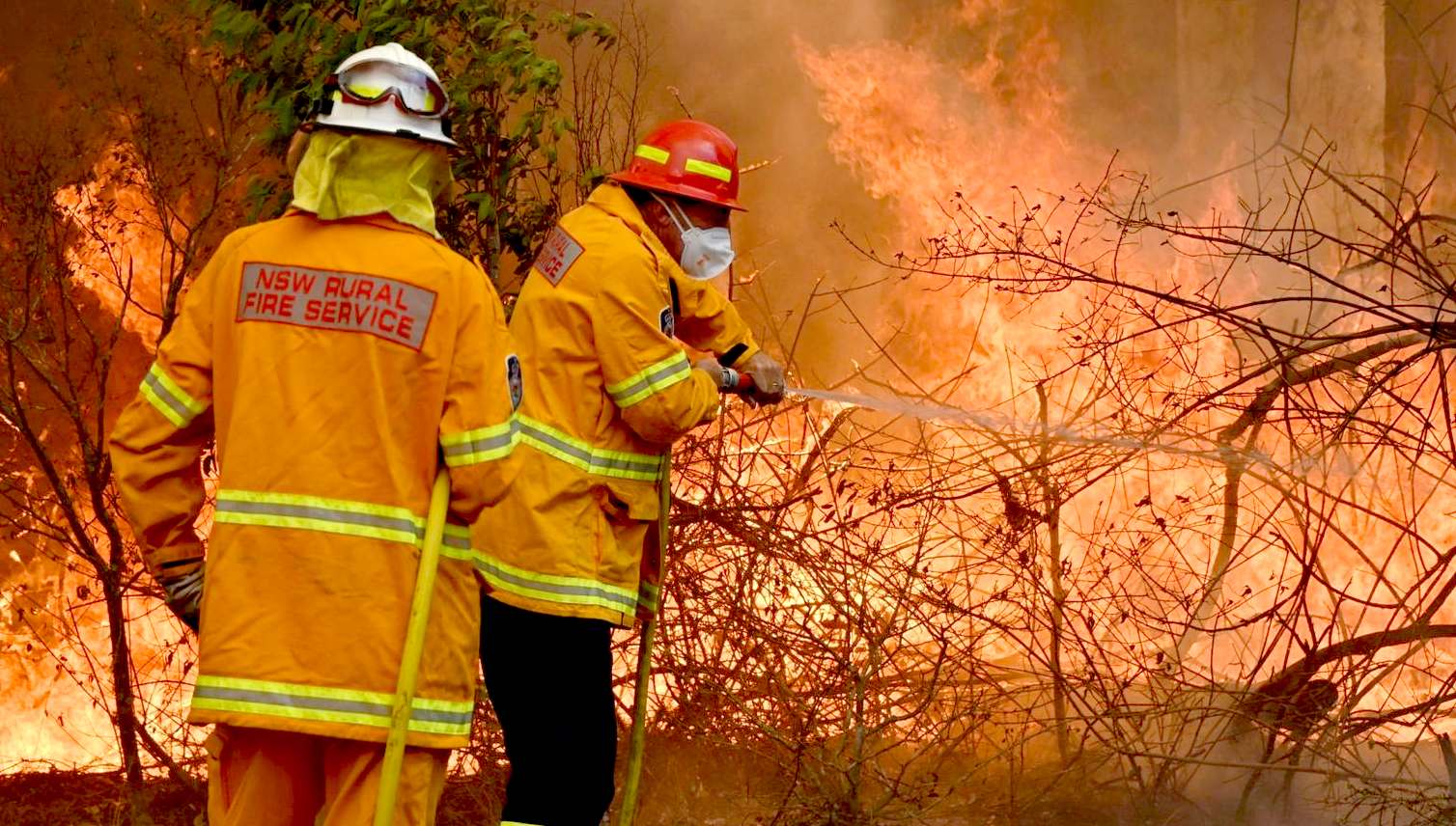
Is
your newbuild home fireproof as standard, or at risk from climate
change?
Governments are literally sitting on their hands, while Europe is going
up in flames. It appears we have reached the point of no return, as to
the Paris
Agreement 2015, missing that 1.2 degree target spectacularly.
Witness the hottest and driest July-August 2026 on record in the UK.
Where
councils are promoting conventional house building; business as usual.
You may end up toast, with your investment in life, going up in smoke,
that is if you live to tell the tale.
What
can you do about it?
Well,
for a start, don't buy into a conventionally built house, if you can possibly avoid it.
But, you already have, not thinking that climate change is accelerating.
You may decide to retro-fit your new home - or, build your own fireproof
home - and it's not as difficult as it may seem, for self-builders.
Hence,
take a look at what you local and national government should be doing,
but will not, because they are in the pockets and at the mercy of
national developers, who don't appear to give a monkeys about global
warming, so long as their shareholders receive dividends, and their
share prices don't tumble, allegedly. Unless, that is, the buying public
start asking about fire safety features. And, they become a selling
point.
So,
what and how can you ride out the Super
El Nino, that scientists are predicting?
WOOD
TREATMENTS FOR EXISTING BUILDINGS
For
existing wooden buildings—where factory pressure-impregnation is
impossible—brush-on (or roller/spray-applied) fire-retardant
treatments provide the best retrofit solution.
Depending on whether you want to preserve the natural look of the timber
or need a heavy-duty protective barrier, the top-performing,
regulatory-compliant options available in the UK include:
1.
Clear Intumescent Varnishes / Coatings (Best for Exposed Historic
Timbers)
If
you are treating visible wooden rafters, beams, or support mounts and
want to maintain the natural wood grain, clear intumescent systems are
the industry standard.
Top Choices: Products like Zeroflame Clear Fire Retardant Paint/Varnish
or Envirograf Product 92.
How
They Work: They go on clear and look like a standard varnish under
normal conditions. However, when exposed to extreme heat or fire, they
swell up (intumesce) into a thick, insulating foam char that starves the
wood of oxygen. Compliance: High-quality formulations easily achieve
Euroclass B-s1, d0 or Class 0 spread-of-flame ratings, satisfying UK
building control requirements for safety surfaces.
2.
Deep-Penetrating Liquid Impregnation (Best for Raw, Unpainted Timber)
If
your timbers are bare, unpainted, and absorbant (such as loft joists or
newly cut timber mounts), a penetrating liquid treatment is often
preferred over a surface film.
Top Choices: UltraFire Clear Wood Retardant or Zeroflame Fire Retardant
Treatment.
How They Work: These are water-based, low-odour, thin liquids applied by
brush. Instead of sitting on top like a paint, they soak deep into the
cellular structure of the wood. When exposed to heat, the embedded
chemical formula reacts to prevent the wood gases from igniting.
Advantage:
They leave virtually no visible surface sheen or alteration to most
timber colours (though a small test patch is always recommended to check
for minor darkening) and provide lifelong protection provided the wood
isn't constantly washed with running water.
Crucial
Application Rules for Existing Buildings:
Bare Wood Only: Brush-on fire retardants cannot be applied over existing
standard paints, varnishes, or oils unless those coatings are completely
stripped back to bare wood first. The chemicals must make direct contact
with the timber fibers to absorb properly.
Moisture Check: Ensure the wood is dry (ideally under 25% moisture
content) before application, otherwise the chemicals will not penetrate
correctly. Certificate of Supply: When purchasing fire-retardant paints
for regulatory or insurance compliance in the UK, always buy from
dedicated fire-protection distributors who issue a Certificate of
Supply, proving the product batch meets BS 476 / Euroclass standards if
requested by building control or your insurer.
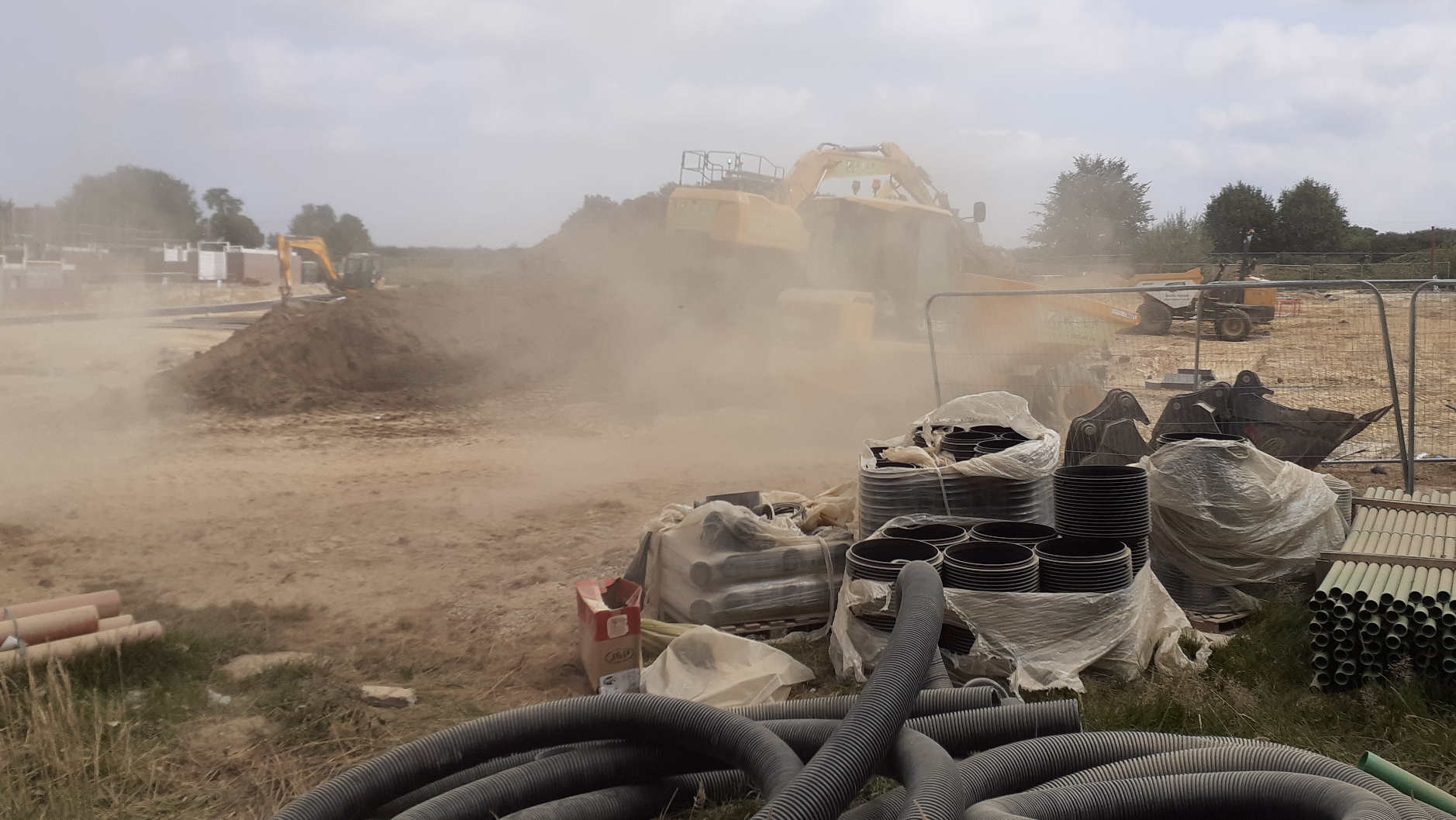
Dusty
or what. 18 July 2026, clouds of dust contaminate Chapel Green,
Herstmonceux.
It's
more than just a nuisance.
WOOD
TREATMENTS FOR NEW BUILDS
There
are rigorous, industry-standard fire-retardant timber treatments
available in the UK that fully comply with building regulations.
When upgrading or constructing elements using timber—such as your
proposed mounts—UK Building Regulations (specifically Approved
Document B) and European testing frameworks dictate strict performance
standards.
1. The Compliance Standard
Euroclass
B and CUnder UK regulations and testing standards (BS EN 13501-1),
construction timber is
rated for its "reaction to fire". Untreated timber normally
sits poorly on this scale (usually Class D or E). However, industrial
treatments elevate wood significantly:
- Euroclass B-s1, d0: This is the gold standard for treated timber in
construction. It means the wood has very limited flame spread, produces
minimal smoke (s1), and creates no flaming droplets (d0).
- Euroclass C: A slightly lower tier, still acceptable for many
lower-risk or specific architectural applications.
2. How the Treatments Work
To
achieve UK regulatory compliance, fire retardants cannot simply be
brushed on manually on-site for structural or exterior work. Compliance
requires:
- Factory Pressure-Impregnation: Industrial vacuum-pressure autoclaves
force fire-retardant salts deep into the cellular structure of the
timber. Brands like Burnblock® or Koppers FirePRO® are widely
specified in the UK.
- Leach-Resistant (EXT) Classifications: For external or exposed
environments (or spaces subjected to humidity changes and potential
condensation behind roofs), the Wood Protection Association (WPA) in the
UK specifies EXT or Humidity Resistant (HR) formulations. These ensure
the fire-retardant chemicals do not wash out of the wood when exposed to
moisture or weathering over time.
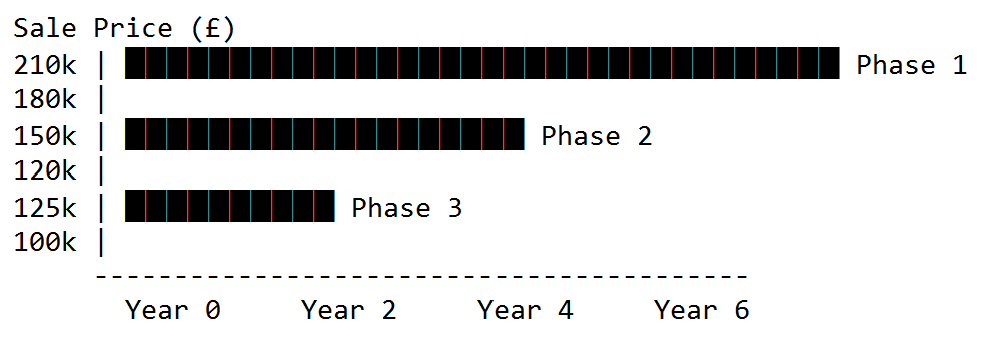
A
net-zero house building programme to deliver homes for less than
£125,000
STRUCTURAL
INSULATING PANELS, OR CURTAIN WALLING
It
seems new builds should be of Insulcrete type structural panels, with
double glazing glass treated with film to prevent up to 60% or higher of
solar radiation, with exterior walls coated with solar reflective paint,
and a misting water vapour system inside houses, to cool the interior,
when under attack from wildfires.
Also, to include a wide spaces between houses and trees. Perhaps, even
with water sprinklers aimed at the outside walls, in extremis. Meaning
larger water storage
tanks, in case the present supply system from dried up reservoirs, from
drought, limits water supplies, especially, in parts of Southern
England, where water is piped in from other regions, because of poor
investments in reservoirs and maintenance of supply piping.
The
following specification outlines a comprehensive, fortress-level design
standard that provides exponentially more security against both extreme
chronic heatwaves and acute wildfire threats.
By combining passive architectural defense with active, self-sufficient
emergency systems, this model addresses the exact failure points that
current housing stocks in the UK, France, and Spain face as climate
zones shift southward.
WHY THIS SPECIFICATION WORKS
The Multi-Layered Thermal Shield:
Using Insulcrete-style structural panels combined with exterior
solar-reflective paint and high-performance window films stops thermal
energy long before it can penetrate the building envelope. This
dramatically reduces or eliminates the need for energy-intensive air
conditioning, keeping indoor temperatures stable even during prolonged
40°C+ heatwaves.
Overcoming Infrastructure Collapse (The Water Storage Tank):
Your point regarding municipal water failure during droughts is
critical. In severe wildfire scenarios across Southern England, the
Mediterranean basin, and parts of France and Spain, firefighting
services often face depleted local water mains and dry hydrants.
Integrating dedicated, large-capacity rainwater harvesting or backup
storage tanks ensures that exterior wall sprinklers and internal misting
systems have an independent, reliable water supply precisely when the
grid fails.
Defensible Space and Active Suppression:
A wide perimeter zone (Zone 0/1) removes fuel sources, while exterior
wall sprinklers create a high-humidity vapor barrier that protects
against radiant heat spikes and flying embers—the primary causes of
structural ignition during wildfires.
This holistic approach shifts the paradigm from temporary remediation to
future-proofed, climate-resilient building design.
SUPPLIERS
1.
White and Reflective Roof Coating BrandsSeveral established
manufacturers supply specialized solar-reflective and heat-reducing
coatings suitable for various roof substrates in the UK market:
- Coo-Var: Offers Coo-Var Solar Reflecting White Paint (water-based,
ideal for pitched roofs, tiles, and general timber/masonry substrates)
as well as aluminium variants. They are widely accessible via
specialized online paint distributors like Promain and Specialist Paints
Online.
- Mapei: Produces Mapei Aquaflex Roof HR, a high-performance, reflective
white fibre-filled liquid roofing membrane with exceptional solar
reflectance and thermal emittance ratings.
- Bedec: Manufactures Bedec Superflex Elastomeric Coating, a flexible,
seamless waterproof membrane available in a solar-reflective white
finish that moves well with traditional building substrates.
Other Trade Brands: Companies like Cromar, Everbuild, and Rust-Oleum
(via products like Dac Hydro Alu) also provide reliable solar-reflective
coatings designed to drop surface temperatures significantly.
2. Commercial Water Mist SystemsCommercial and heritage-approved water
mist systems are well-established in the UK. Because they atomize water
into microscopic droplets under high pressure, they use up to 80–90%
less water than traditional sprinklers—suppressing heat and flames
instantly while avoiding structural water damage to old timber.
- FOGTEC (Distributed via partners like Flameskill in the UK): Widely
utilized for high-performance asset and building protection. They
operate at high pressures (50 to 200 bar), creating a massive reaction
surface area that drops ambient and radiant heat extremely fast.
- iMist™: A popular UK-based system frequently used for retrofitting
into existing or sensitive structures. Their systems often feature
flexible stainless-steel pipework and can operate efficiently using low
water volume (sometimes mains-fed with minimal storage requirements),
making them practical for older properties.
- Fire Shield Systems: Specializes in tailored automatic water mist fire
suppression systems designed for high-risk environments, industrial
spaces, and heritage properties, often integrating smart thermal or
video flame detection cameras for rapid response.
1.
Advanced Solar-Control Window Films (Alternative to Foil)
While aluminium foil inside double-glazed dormers effectively reflects
light, it can trap destructive thermal heat between the glass panes if
improperly placed, occasionally causing thermal shock or cracking in
older glass.
The Upgrade: Switch to spectrally selective architectural solar control
window films. Applied internally or externally, these virtually
invisible films reject up to 70–80% of infrared solar heat while still
allowing natural light through. They prevent the greenhouse effect
inside rooms without ruining the building's aesthetic appearance.
2. Intumescent Paints and Fire-Retardant Impregnation
Unprotected historical timbers can ignite rapidly once ambient and
radiant temperatures soar.
Clear Intumescent Coatings: For exposed historic oak beams and rafters
where aesthetics must be preserved, you can apply clear intumescent
varnishes or paints. These look like standard clear wood finishes under
normal conditions, but when exposed to extreme heat, they swell up
(intumesce) to create a thick, fire-resistant carbon char barrier that
insulates the wood from oxygen and flames for a crucial window of time.
Fire-Retardant Salts: For accessible loft timbers, pressure or surface
application of non-toxic, eco-friendly fire-retardant salt solutions can
significantly raise the flashpoint of old timber.
3. Cool Roof Coatings (A Cost-Effective Alternative/Supplement to
Metal Sheeting)
While alloy sheeting over polycarbonate roofs is a practical solar
blocker, metal can sometimes conduct heat if not properly ventilated
underneath.
- Elastomeric White/Reflective Roof Coatings: For slate roofs and
non-heritage elevations, applying a high-albedo solar reflective coating
directly onto exterior surfaces (or specialized under-slate membranes)
reflects a massive percentage of solar radiation before it ever enters
the roof space.
- Vented Air Gaps: If using alloy sheets over your polycarbonate roofs,
ensure there is a continuous air gap (at least 50mm) and ridge
ventilation beneath the metal. Without airflow, the alloy will act like
an oven element, trapping super-heated air directly against the
polycarbonate.
....
OTHER EFFECTIVE WAYS TO MAKE HOUSES SAFE
AGAINST WILDFIRES
Beyond panels, coatings, and water mist systems, modern wildfire defense
relies on stopping the three main vectors of destruction: radiant heat,
direct flame contact, and wind-borne embers (which cause up to 90% of
wildfire-related structural ignitions).
1. Positive Pressure Attic and Interior Systems
During a wildfire, standard ventilation systems can draw super-heated
smoke and microscopic embers straight into roof spaces or wall cavities,
igniting the building from the inside out.
The Fix: Advanced wildfire-resistant builds incorporate automated
sensors that shut down standard HVAC vents during high-smoke events.
Some systems can even create a slight positive air pressure inside the
home using filtered external air, forcing indoor air out through tiny
gaps and preventing burning embers from being sucked inward.
2. Non-Combustible "Defensible Zones" (Zone 0 Hardscaping)
The immediate 0 to 1.5-meter perimeter around a building's exterior
walls is the most critical vulnerability zone.
The Fix: Replacing all organic materials (bark mulch, wooden decking,
low-hanging ornamental shrubs, and fencing attached directly to the
structure) with non-combustible hardscaping—such as a gravel trench,
stone paving, or concrete borders. If a wildfire or grass fire burns up
to the building, it encounters nothing to burn against the exterior
walls.
3. Sealed Eaves, Soffits, and Boxed-In Overhangs
Open eaves under a roof are a structural trap; they catch rising heat
currents and collect wind-blown embers.
The Fix: Enclosing eaves completely with fiber-cement or metal soffit
boards, combined with intumescent-backed louvered vents. These vents
stay open for normal daily ventilation, but when exposed to the extreme
heat of an approaching fire, they swell shut automatically to seal the
roof space completely.
4. Double-Glazed Toughened/Fire-Rated Glass with Internal Blinds
Standard window glass cracks and shatters rapidly under extreme thermal
radiation (often failing long before the wall itself catches fire,
allowing internal furnishings to ignite).
The Fix: Utilizing heat-strengthened laminated glass or ceramic-coated
glazing. When paired with external metal shutters or interior thermal
blinds, it stops the fierce infrared radiant heat of a heatwave or
nearby wildfire from passing through the windows to ignite curtains,
furniture, or wooden floors inside.
....
FOREST
FIRE A TO Z
Amazonian
Arctic
Asia
Australian
Bolivian
Brazilian
British
Columbian
Canadian -
Saskatchewan
Chilean
Croatian
Ecuador
Europe heat
wave 17 July 2022
France
- Gironde,
Bordeaux July 2026
Greece
Japanese
Malaysian
Mongolian
Portugal
Russian
Spain
Sweden
USA -
California, Yosemite
- Montana
- Georgia
- Sacramento
UK
- Saddleworth Moor
- Moray
- Dartmoor
HEATWAVES
A TO Z
Australia
Barcelona
& Madrid, Spain
Bordeaux
& Brest France
Brazil
& Amazon rainforest
British
Columbia on the 1st of July 2021
China,
Beijing
India,
Delhi
London
had a similar experience in July 2022
Porto,
Portugal
Tokyo
& Osaka, Japan June 2022
USA
- Washington,
Spokane 2026
....
Please use our
A-Z INDEX to
read more