
Is
your newbuild home fireproof as standard, or at risk from climate
change?
WHAT IS CLIMATE
CHANGE?
Climate change refers to long-term shifts in temperatures and weather patterns. Such shifts can be natural, due to changes in the sun’s activity or large volcanic eruptions. But since the 1800s, human activities have been the main driver of
climate
change, primarily due to the burning of fossil fuels like coal, oil and gas.
Burning fossil fuels generates greenhouse gas emissions that act like a blanket wrapped around the Earth, trapping the sun’s heat and raising temperatures.
The main greenhouse gases that are causing climate change include carbon dioxide and methane. These come from using gasoline for driving a car or
coal for heating a building, for example. Clearing land and cutting down forests can also release
carbon
dioxide. Agriculture, oil and gas operations are major sources of methane emissions. Energy, industry, transport, buildings,
agriculture and land use are among the main sectors causing greenhouse gases.
HUMANS
DRIVE GLOBAL WARMING
Climate scientists have showed that humans are responsible for virtually all global heating over the last 200 years. Human activities like the ones mentioned above are causing
greenhouse gases that are warming the world faster than at any time in at least the last two thousand years.
The average temperature of the Earth’s surface is now about 1.44°C warmer than it was in the late 1800s-prior to the industrial revolution-and warmer than at any time in the last 100,000 years. The last decade (2015-2024) was the warmest on record, and each of the last four decades has been warmer than any previous decade since 1850.
Many people think that climate change mainly means warmer temperatures. But temperature rise is only the beginning of the story. Because the
Earth is a system where everything is connected, changes in one area can influence changes in all others.
The consequences of climate change include, among others, intense droughts, water scarcity, severe fires, rising sea levels, flooding, melting polar ice, catastrophic storms and declining
biodiversity.
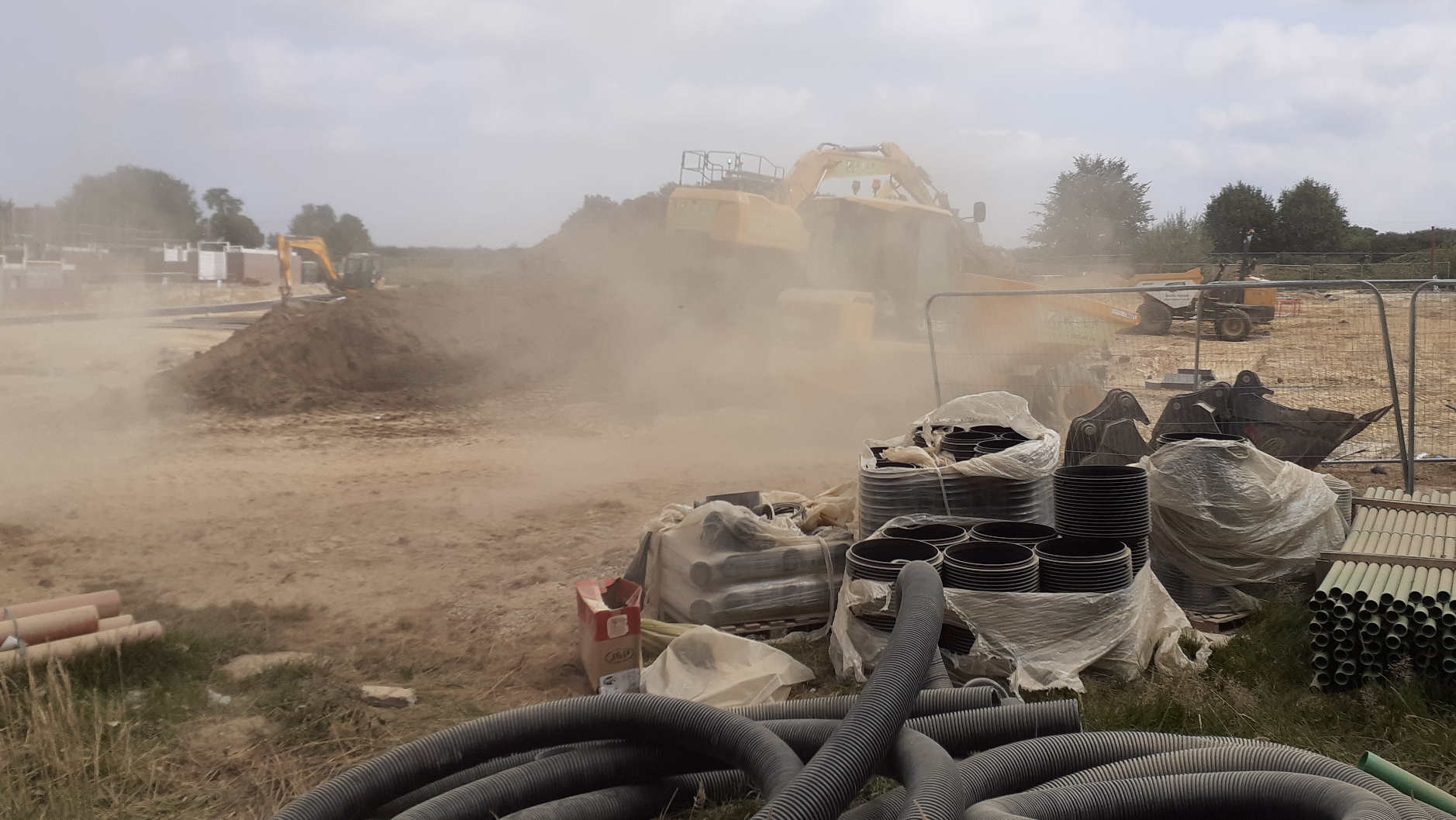
Dusty
or what. 18 July 2026, clouds of dust contaminate Chapel Green,
Herstmonceux.
It's
more than just a nuisance.
The UK Government is not moving fast enough to reduce greenhouse gas (GHG) emissions and to protect households and businesses from volatile fossil fuel
prices, drought or wildfires. The war in Iran has led to the second global fossil fuel price shock in just four years. In this uncertain geopolitical context, many countries are responding with plans to provide secure, homegrown energy by rapidly reducing dependency on fossil fuels. To do this in the UK, the Government needs a more ambitious plan to electrify the UK. This requires continued progress towards low-carbon electricity and an accelerated roll-out of electric vehicles (EVs), heat pumps, and industrial electrification.
In October 2025, the UK Government published its Carbon Budget and Growth Delivery Plan (CBGDP), setting out its policies and plans for meeting carbon budgets. This plan projects slower emissions reductions for surface transport and buildings compared to the previous government’s plan. This reflects both slow prior progress in the roll-out of some technologies, as well as areas of reduced policy ambition. For example, the decarbonisation of public sector buildings and reduced support for low-income homes to electrify heating and install insulation.
There is now a significant gap between the plan’s projected emissions reductions and the UK’s 2030 Nationally Determined Contribution (NDC) under the Paris Agreement, a commitment to reduce emissions by at least 68% compared to 1990 levels. Increasing ambition and achieving the 2030 NDC would put the UK on track to achieve its future carbon budgets and Net Zero by 2050, and send a strong international signal of commitment to delivery.
The slow pace of electrification is putting the UK’s climate targets at risk and is a missed opportunity to enhance UK energy security in the face of rising threats, leaving the UK exposed to geopolitical shocks. 93% of the UK’s emissions are now outside the electricity supply sector and around three-quarters of a typical household’s driving and home energy bills are from the direct use of fossil fuels in cars and gas boilers. Following the recent increase in fossil fuel prices, bills have increased almost four times more for a typical household with a gas boiler and a petrol car, compared to a household with a heat pump and an EV. For a rural household with an oil boiler and a diesel car, the increase is 10 times more.
Accelerating EV sales and heat pump installations beyond government plans would help address these challenges. It would keep the 2030 NDC in reach, improve the UK’s air quality, ease inflationary pressures from fossil fuel shocks, and reduce costs for consumers, giving them more spending power elsewhere in the
economy. The UK could save up to 80 million barrels of oil and 1.5 billion therms of gas in 2030, which would cost almost £8 billion at current oil and gas prices. Electrification is the most effective form of energy efficiency: by 2050, the efficiency of a more electrified energy system would reduce wasted energy by around half compared to today.
Progress in other sectors, including agriculture, land use, and aviation, has also been too slow. In addition, the Government’s plan to achieve the Sixth Carbon Budget relies on a rapid ramp-up in engineered removals after 2030 but lacks detail on how this will be achieved.
The rate of global warming is at a record high, and the UK is already experiencing the impacts. Heatwaves have become hotter, longer, and more frequent. In 2026, the highest May temperature on record in the UK was recorded in Greater London. Early 2026 was exceptionally wet in parts of the UK, with long unbroken spells of rain leading to widespread
flooding. The UK can end its contribution to ongoing global climate change by reaching Net Zero emissions and have a resilient transition that simultaneously considers actions to adapt to rising temperatures.
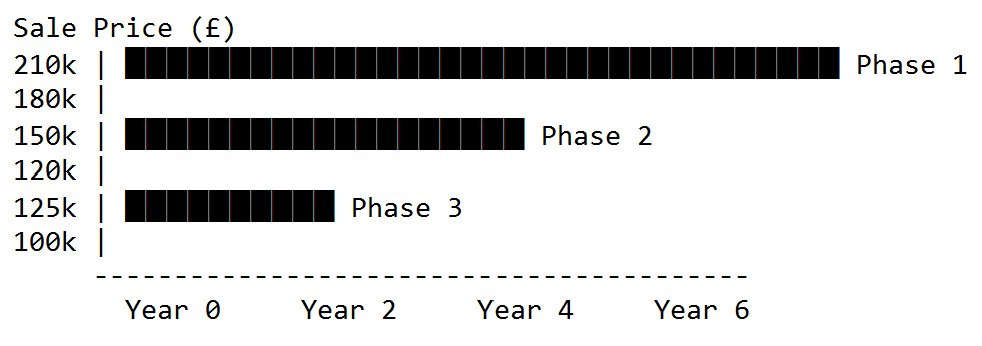
A
net-zero house building programme to deliver homes for less than
£125,000
KEY ACTION FOR ELECTRIFICATION
Rapid progress over the next year is essential to keep the 2030 NDC in reach, with the pace of emissions reduction needing to almost double. To achieve this, the
Government needs a more ambitious plan for electrification. It must urgently remove barriers facing households and businesses to transition to efficient, low-carbon electric technologies. Key actions for electrification include:
1. Make electricity cheaper.
While progress has been made in the past year to remove some policy costs from electricity bills, this is not sufficient to incentivise many households and businesses to transition to low-carbon heating. Remaining policy costs should be removed from electricity bills for both households and non-residential users so that the greater efficiency of heat pumps compared to fossil fuel heating is reflected in lower bills. Lower bills would also improve the case for investing in the UK’s energy-intensive sectors.
2. Create the conditions for a more rapid transition to EVs.
Propelled by the zero-emission vehicle (ZEV) mandate, the market continues to drive down the price of electric cars, allowing more households and businesses to benefit from the lower costs of EV ownership. With clear and consistent incentives and messaging, the adoption of electric cars can outpace current ambition, and the adoption of electric vans can catch-up. To flourish, the UK car industry needs to continue its pivot to the technologies of the 21st century. This requires the Government to stand firm behind the ZEV mandate and remove barriers to EV adoption. Crucial to this is increasing access to affordable charging, allowing the one-third of homes without access to off-street parking to benefit from lower running costs. It is also important to remove regulatory barriers and minimise any ‘hassle factor’ to consumers from the planned introduction of electric vehicle excise duty.
3. Accelerate the installation of heat pumps in buildings.
The UK has one of the lowest market shares of heat pump installations in Europe. The Government must ensure installations accelerate in all segments of the market by:
- Urgently addressing the gap left by the closure of the Energy Company Obligation (ECO) scheme. In the last three years, this scheme accounted for around a third of retrofit heat pump installations in the UK, providing targeted support for low-income households. Without a sufficient replacement, installations could fall significantly this year.
- Removing any unnecessary barriers that make a heat pump harder to install than a gas boiler, so that low-carbon heating installations become the default choice by 2035. This could be done by: reducing regulatory barriers, addressing skills gaps, improving advice to households and businesses, and enabling market conditions which reduce installation costs.
- Introducing a comprehensive programme to decarbonise public sector buildings, following the closure of the Public Sector Decarbonisation Scheme. The Government should consider restricting the installation of fossil-fuel boilers in public buildings. Moving instead to low-carbon combined heating and cooling systems can both reduce fossil fuel dependency and protect vulnerable people from rising temperatures, as set out in the Climate Change Committee’s (CCC) Adaptation Committee report on A Well-Adapted UK, published earlier
IN 2026.
4. Deliver on industrial electrification.
Exemptions to
electricity network and policy costs will not be sufficient to incentivise industrial electrification on their own. The Government should now set out a plan to deliver its ambition for industrial electrification. This should confirm suitable use cases and establish the conditions necessary to make electrification the economically rational choice – addressing both capital and operating cost barriers.
IMPACT OF ELECTRIFICATION ON HOUSEHOLD ENERGY COSTS
A typical UK household will see lower and less volatile bills overall if they have an EV and a heat pump, rather than a petrol car and a gas boiler, under current government policies (Figure 1). This is true for prices both before and since the start of the Iran war, with recent energy cost increases having strengthened this effect.
- Energy prices have risen since the start of the war. Given this, a typical household with a gas boiler and petrol car would save around £1,210 a year by installing solar panels and switching to a time-of-use tariff, a heat pump, and an EV. A rural household with an oil boiler and a diesel car could save around £1,880 a year, even without solar or time-of-use tariffs.
- The majority of savings come from the reduced running costs of electric cars. Most households would now save by switching to an EV, provided they are able to charge at home. However, high public charging costs mean this is not true for all households.
- The Warm Homes Plan increased government support for solar panels and heat pumps. With this support, installing solar panels, combined with time-of-use electricity tariffs available in the market, can make heat pumps cheaper than a gas boiler for a typical household.
* However, not all homes are suitable for solar panels or time-of-use tariffs, and many would not currently save from switching to a heat pump alone.
* Making electricity cheaper would enable many more households to save by switching to heat pumps, and would further reduce the UK’s exposure to volatile international gas markets.
* Installing low-cost insulation measures such as draught proofing and insulating hot water tanks can also help reduce household bills and emissions.
ARE WE MEETING THE 2015 PARIS AGREEMENT TARGETS?
Current policy trajectories put global warming on track for roughly 2.8°C by 2100, while full implementation of national pledges (NDCs) brings that down to 2.3°C–2.5°C. We are missing the primary 1.5°C
Paris Agreement target, and an emissions overshoot past 1.5°C is virtually inevitable within the next decade.
Climate Projections: Best, Current, and Worst Case
Recent modeling from the UN Environment Programme (UNEP) and updated IPCC pathways show that while rapid clean-tech adoption has ruled out extreme 4.5°C+ "runaway coal" futures, slow policy action has rendered the absolute best-case 1.5°C target without overshoot implausible.
A HIGH-IMPACT SECTORAL ACTION PLAN
To reverse course and cap warming as close to 1.8°C as possible, structural decarbonization must focus on four high-leverage sectors:
1. Zero-Emission Housing & Buildings
Retrofit Enclosures: Mandate external wall insulation, triple-pane glazing, and airtightness standards for older housing stock to reduce heating and cooling demands by up to 70%.
Electrification & Thermal Storage: Ban fossil-fuel boilers in new builds, replacing them with air- or ground-source heat pumps paired with domestic thermal batteries (water/phase-change storage).
Passive Design & Microgrids: Integrate passive cooling (shading, thermal mass, night-purge ventilation) and local solar-plus-storage to insulate grid demand during heatwaves.
2. Zero-Emission Transport
Modal Shift Infrastructure: Priority investment in electrified light rail, dedicated bus rapid transit (BRT), and active mobility corridors to cut private vehicle miles traveled (VMT).
Grid-Integrated Fleet Electrification: Transition light-duty vehicles to battery electric vehicles (BEVs) utilizing Bidirectional Charging (V2G) to buffer grid spikes during high air-conditioning loads.
Heavy Transport Decarbonization: Shift long-haul freight to electrified rail wherever possible, reserving hydrogen or e-fuels strictly for heavy aviation and maritime sectors.
3. Agrifood Transition (Diet & Land Use)
Caloric Shift to Cereals & Legumes: Transitioning dietary protein reliance from ruminant livestock (beef/mutton) toward grains, legumes, and coarse cereals directly frees up to 75% of global agricultural land while cutting methane emissions.
Regenerative Cropping: Adopt low-tillage practices, cover crops, and crop rotation to preserve topsoil moisture during drought conditions and restore soil organic carbon.
4. Strategic Reforestation & Ecosystem Restoration
Native Ecosystem Restoration: Prioritize multi-species natural regeneration over monoculture tree plantations, targeting degraded non-arable lands, riparian zones, and peatlands.
Urban & Peri-Urban Forestry: Expand urban canopy cover to mitigate the "urban heat island" effect, lowering ambient street temperatures by 2°C to 4°C during peak summer waves.
Bio-Drainage & Agroforestry: Integrate deep-rooting trees along agricultural borders to retain groundwater tables, reduce wind erosion, and stabilize localized rainfall microclimates.
WHAT POLICY CHANGES WILL THE UK HOTHEADS NEED TO MAKE?
Translating high-level climate ambitions into reality requires moving from voluntary targets to enforceable statutory frameworks. While individual actions help, arresting the expansion of desertification across Mediterranean and Southern Europe requires systemic policy shifts in the UK and deep multilateral cooperation among the world's top emitters.
UK Policy Framework: Concrete Legislative Reforms
For the UK to achieve the housing, transport, and land-use goals, several key legislative and regulatory shifts are required:
1. Housing & Buildings Sector
Statutory Future Homes & Buildings Standard Reform: Require all new residential developments to be net-zero operationally from day one (incorporating passive cooling, heat pumps, and mandatory rooftop solar PV) while eliminating gas grid connections for new construction.
Minimum Energy Efficiency Standards (MEES) Escalation: Re-introduce and enforce strict private rented sector targets—requiring landlords to reach EPC Rating B by 2030—backed by low-interest green improvement loans (e.g., via the National Wealth Fund).
Embodies Carbon Caps: Integrate mandatory maximum embodied carbon limits per square meter into Building Regulations (Part L/Part Z) to drive the shift from energy-intensive concrete/steel to sustainably sourced timber and low-carbon materials.
2. Transport & Infrastructure
Strengthened Zero Emission Vehicle (ZEV) Mandate: Maintain non-negotiable sales trajectory targets forcing auto manufacturers to transition 100% of new car and van sales to zero-emission models well before 2035.
National Grid Connection Overhaul: Reform the "first-come, first-served" grid connection queue to fast-track commercial-scale battery storage, heat pump deployment, and EV ultra-rapid charging hubs.
Road Investment Reallocation: Reallocate a substantial portion of the national road-building budget directly into municipal active travel corridors, bus rapid transit (BRT), and regional rail electrification.
3. Agriculture, Food & Forestry
Environmental Land Management (ELM) Scheme Alignment: Link public agricultural subsidies under ELM directly to carbon sequestration metrics—paying farmers to transition arable land from livestock feed to human-consumption cereals/pulses, agroforestry, and wetland restoration.
Statutory Spatial Land Use Framework: Publish a legally binding Land Use Framework balancing housing, food security, bioenergy, and tree-planting targets to prevent land-use conflicts.
HOW MIGHT OTHER NATIONS WORK TOGETHER TO STOP EUROPE BECOMING A
DESERT?
Multilateral Coordination: Saving Europe from Desertification
Southern Europe (the Mediterranean basin, Iberian peninsula, and parts of France/Italy) faces severe soil degradation, drying river basins, and advancing aridification driven by rising vapor pressure deficits. Arresting this trend requires coordinated global and regional action among major emitters (US, EU, UK, China, India):
- Targeted "Climate Clubs" & CBAM Harmonization: Top emitters must align Carbon Border Adjustment Mechanisms (CBAMs). By penalizing high-carbon imports globally, major economies create a commercial incentive for heavy industrial polluters to decarbonize, preventing carbon leakage and generating revenues that can be funneled into
Mediterranean adaptation funds.
- Transboundary Water & Drought Treaties: Expand European and North African water-sharing agreements. Top emitters with advanced space/data capabilities (US NASA, EU Copernicus) can deploy real-time satellite moisture monitoring networks to optimize cross-border aquifer management and precision agricultural irrigation across southern jurisdictions.
- Strategic Ecosystem Alliances: Establishing a "Great Green Wall for Southern Europe"—a coordinated belt of drought-resistant, deep-rooting native vegetation stretching across vulnerable Mediterranean latitudes. Major economies must fund this via international carbon offset frameworks built on strict biodiversity criteria rather than monoculture timber plantations.
- Agricultural Innovation Sharing: Joint R&D alliances between agricultural superpowers (China, US, EU, India) to open-source climate-resilient, drought-tolerant cereal crops, bio-char soil restoration techniques, and low-water hydroponics for heat-stressed zones.
WHAT ABOUT SOLAR AND HYDROGEN FOR SHIPPING?
Could such a system, linked to renewable methanol, and solar panelled hybrids, make a useful contribution to reducing overall global warming?
Hybrid systems that combine onboard renewable energy harvesting with green hydrogen derivatives (like renewable e-methanol) offer one of the most practical pathways to decarbonize global maritime shipping, which accounts for roughly 3% of global greenhouse gas emissions (approx. 1 billion tonnes of $CO_2$
annually).
What the Elizabeth Swann Concept Demonstrates
The proposed Elizabeth Swann vessel—a 140-foot trimaran concept utilizing articulated
solar arrays, wind-harvesting wing sails, and
hydrogen fuel cells—serves as a high-efficiency technology testbed rather than a direct blueprint for massive cargo ships. Hull Efficiency & Micro-Grid Integration: Its trimaran design reduces hydrodynamic drag, allowing modest renewable inputs (50–90 kW solar arrays) to propel the hull faster than traditional vessel geometries.
Onboard Energy Storage: By pairing solar panels with onboard hydrogen fuel cells, the design illustrates how surplus renewable energy can be converted to hydrogen to provide continuous power during low-sun conditions. While a 20,000-container cargo ship cannot run on solar alone due to surface-area-to-weight limits, the Elizabeth Swann's hybrid approach highlights how primary fuel demands can be significantly offset.
How a Solar-Hydrogen-Methanol Hybrid System Works at Scale
For commercial deep-sea fleets, no single clean energy source satisfies all operational needs. A multi-layered hybrid architecture solves the energy density
problem:
1. Onboard Solar & Wind-Assist (10%–25% Fuel
Reduction)
Rigid wing sails equipped with flexible solar panels capture free ambient energy during ocean transits. This directly powers auxiliary systems (cooling, lighting, pumps) and assists main propulsion, lowering the vessel's overall fuel consumption
baseline.
2. Green Hydrogen & Fuel Cells (Zero-Emission Port
Operations)
Pure compressed or liquid green hydrogen ($H_2$) powers onboard fuel cells for harbor maneuvers and "cold ironing" (powering the ship while berthed). This eliminates toxic localized pollutants ($NO_x$, $SO_x$, and particulate matter) in coastal ports without requiring massive cryogenic tanks for whole ocean
transits.
3. Renewable Methanol (Deep-Sea Transoceanic
Power)
For the primary propulsion on long ocean routes, e-methanol (produced by combining green hydrogen with captured biogenic $CO_2$) provides the dense chemical energy required:
Liquid at Ambient Temperatures: Unlike pure hydrogen, e-methanol stores easily in standard fuel tanks and requires minimal modification to existing bunkering infrastructure.
Dual-Fuel Engines: Commercial shipping lines (such as Maersk) are already deploying dual-fuel methanol vessels that can achieve net-zero lifecycle emissions when powered by green methanol.
Scalability and Climate Contribution
If rolled out across international merchant fleets in alignment with International Maritime Organization
(IMO) targets, this hybrid framework would deliver substantial climate benefits:
Emissions Abatement: Widespread adoption of wind/solar-assisted propulsion combined with e-methanol could eliminate up to 800 million tonnes of $CO_2$ equivalent per year by 2050.Fuel Cost Mitigation: Green fuels like e-methanol currently carry a 2x to 3x cost premium over heavy fuel oil (HFO). Maximizing onboard solar and wind harvesting reduces the total volume of expensive green fuel a ship must purchase per
voyage.
Infrastructure Bottlenecks: The primary barrier is not vessel engineering, but the global supply of green hydrogen and biogenic carbon needed to synthesize e-methanol at commercial scale.
WHAT ABOUT TRUCKS AND AVIATION?
Trucks in particular need long ranges to deliver goods, but there is no infrastructure at present, to provide the methanol that they will need. Cars and vans also come into the picture. Then, there is load levelling, for the solar panels and wind turbines that produce clean electricity. The proposed SmartNet (formula) system is a replacement to the national electricity grid, with a series of service stations that convert green electricity to hydrogen, then to methanol. These service stations could be flatpacks, for quick installation. How might the
SmartNet system help the UK and the world, meet their electrification and zero carbon transport targets?
A decentralized, modular network of multi-fuel hubs—such as the proposed SmartNet concept—addresses two of the hardest challenges in the clean energy transition: grid congestion from intermittent renewables and the range limits of heavy transport. By co-locating electrolysers, fuel synthesis, and storage directly at transport nodes or near generation sites, such a system acts as both a power-to-liquid (PtL) buffer and a multi-fuel refueling corridor.
Grid Load Levelling & Curtailment Mitigation
Absorbing Peak Surpluses: When offshore wind or utility solar generation exceeds local grid capacity, transmission congestion forces operators to pay generators "curtailment fees" to power down. Local electrolyser hubs can absorb this excess off-peak electricity, turning wasted kinetic and radiant energy into chemical energy.
Distributed Power Balancing: By decentralizing energy storage into modular, "flatpack" stations, the load is balanced locally at the distribution network level (DSO) before it can cause high-voltage transmission bottlenecks (TSO).Grid Resilience & Back-up: Stored hydrogen or synthetic fuels can be fed back into
fuel cells or stationary turbines during wind droughts or peak evening demand spikes, providing long-duration energy storage (LDES) that lithium-ion batteries cannot economically match over days or weeks.
Unlocking Zero-Emission Long-Haul Transport
Commercial Freight & Heavy Logistics: Long-haul Class 8 trucks and heavy goods vehicles (HGVs) require massive energy density to maintain payload capacity and rapid turnaround times. E-methanol provides a liquid fuel density comparable to diesel, enabling long ranges without carrying multi-ton battery packs.
Modular "Flatpack" Scalability: Standardized, prefabricated stations lower civil engineering costs and permit lead times, allowing fast-tracked deployment along major freight corridors (such as the UK’s M1/M6 corridors) before full high-voltage grid upgrades are completed.
Flexibility for Cars and Light Commercial Vehicles: While battery electric vehicles (BEVs) dominate light passenger cars, multi-fuel hubs can offer ultra-rapid DC charging backed by local hydrogen fuel cell generators alongside liquid e-methanol pumps for dual-fuel or converted vehicles.
Converting Existing ICE Fleets (The Legacy Vehicle Challenge)
Bridging the Transition Period: Replacing the entire global fleet of internal combustion engine (ICE) vehicles takes decades. Converting existing petrol and diesel engines to run on e-methanol provides an immediate pathway to decarbonize the existing rolling stock without waiting for total fleet turnover.
Closed-Loop Carbon Neutrality: Because green e-methanol is synthesized by combining green hydrogen (via water electrolysis) with captured biogenic or direct-air-captured carbon dioxide ($CO_2$), burning it in an engine releases only the carbon previously extracted from the atmosphere, creating a net-zero lifecycle.
Critical Engineering & Policy Considerations
Round-Trip Energy Efficiency: Direct electrification (charging a battery) operates at 75%–85% efficiency. Converting electricity to hydrogen, and then to methanol, and finally burning it in an internal combustion engine yields a total efficiency of roughly 15%–25%. E-methanol should therefore prioritize heavy transport, aviation, and shipping rather than replacing direct BEV charging where feasible.
Biogenic $CO_2$ Feedstock Supply: Producing scalable e-methanol requires continuous sources of captured biogenic $CO_2$ (from anaerobic digestion, bio-energy plants, or direct air capture), which requires dedicated carbon supply chains.
HOW MIGHT POLITICIANS STEER OEM'S & GRID OPERATORS TO INVEST IN SUCH TECHNOLOGY?
Governments rarely succeed by appealing to altruism or moral duty; corporations redirect capital when political frameworks reshape market incentives so that continuing "business as usual" becomes more expensive than innovating.
To force legacy energy majors, Original Equipment Manufacturers (OEMs), and grid operators to invest in infrastructure like SmartNet or green e-methanol, policymakers rely on specific regulatory mechanisms:
POLICY INSTRUMENTS TO SHIFT CAPITAL
1. Binding Mandates and Penalties
- Strict Sales Quotas: Rather than relying on subsidies, frameworks like the UK’s Zero Emission Vehicle (ZEV) Mandate require auto manufacturers to sell a rising percentage of zero-emission vehicles annually (e.g., 33% in 2026, scaling to 100% by 2035). Non-compliant OEMs face heavy financial penalties per non-compliant vehicle.
-
Upstream Carbon Pricing (e.g., EU ETS2): Carbon pricing mechanisms are shifting upstream directly to fuel distributors.
When fossil fuel distributors must buy allowances for every liter of petrol or diesel sold, dirty fuels become systematically more expensive, protecting the commercial margins of alternative clean fuels like e-methanol.
-
Mandatory Renewable Fuel Blending: Legislation can mandate that fossil fuel majors blend an increasing percentage of e-fuels into standard pumps each year, creating a guaranteed, captive market for off-take agreements.
2. Derisking Infrastructure Investment
Concessionary Capital: Government-backed institutions (such as the UK Infrastructure Bank) can provide first-loss equity or low-interest guarantees for "first-of-a-kind" modular hubs. Once the technology and business model are proven, private institutional capital enters to scale the network.
Contracts for Difference (CfD) for Clean Fuels: Similar to how wind power was scaled, governments can offer revenue-stabilization contracts for green hydrogen and e-methanol. If market prices fall below production costs, the state covers the delta, giving energy investors bankable long-term revenue certainty.
3. Regulatory Streamlining for Grid & Planning
Anticipatory Grid Investment: Regulators can permit Distribution Network Operators (DNOs) to charge consumers small fees to build grid capacity ahead of demand, eliminating the multi-year queue for new connections.
Fast-Track Spatial Planning: Permitting modular "flatpack" energy stations requires classifying them as critical infrastructure, lowering regional planning friction and reducing lead times from years to months.
Turning Incumbents into Allies
Energy majors hold massive balance sheets, global distribution networks, and chemical processing expertise. The political strategy focuses on leverage points that compel them to pivot:
- Stranded Asset Risk: Pension funds and institutional investors increasingly pressure energy boards to show credible 2030–2050 transition plans, recognizing that refineries and traditional gas stations risk becoming write-offs as fossil transport declines.
- Repurposing Asset Value: Solutions like SmartNet allow fuel suppliers to retain their prime real estate—their network of service stations—while transitioning their product line from refined petroleum to green hydrogen and e-methanol.
- Industrial Scale Advantages: Chemical majors already possess the engineering capacity required for large-scale power-to-liquid synthesis, positioning them to win market share in heavy transport fuels if given clear, long-term policy direction.
GOING ALL ELECTRIC RENEWABLES
To meet total UK electricity demand—covering homes, business, heating, and electric transport—the nation's electricity consumption will roughly double from ~320 TWh today to 600–700 TWh annually by 2050. Because wind and solar operate on variable capacity factors (offshore wind works at ~45–50% average capacity, onshore wind at ~30%, and UK solar at ~10–12%), the total installed generator capacity must be 2 to 3 times larger than peak demand. Suppliers like Octopus Energy—who manage both retail supply and renewable investment funds—will rely on a combined fleet of approximately 15,000 to 18,000 total wind turbines alongside thousands of solar installations across the country.
Net Zero UK Renewable Energy Hardware Requirements

Renewable Source
Target Capacity (2050) Estimated Hardware Required
Land / Sea Footprint
Offshore Wind100 GW – 140 GW7,000 – 9,500 turbines (Based on modern 15 MW mega-turbines)~5% of the UK’s Exclusive Economic Zone seabed.
Onshore Wind30 GW – 45 GW6,000 – 9,000 turbines (Based on standard 5 MW land turbines)~0.5% – 1% of UK total land area
Solar PV (Farms & Rooftops) 70 GW – 100 GW~1,500 – 2,500 major solar
farms (Plus 8+ million rooftop domestic systems)~0.6% – 0.8% of UK land area (roughly 140,000–200,000 hectares)
Crucial System Factors Beyond the Hardware Count
Turbine Power Scale: Modern turbines are significantly larger than legacy models. A single 15 MW offshore turbine (such as those deployed in the North Sea) generates enough power in one rotation to run an average household for over two days.
Overbuilding for Low-Wind Days: To ensure suppliers can deliver power during a summer wind lull or a winter freeze
(Dunkelflaute), the UK must "overbuild" total renewable capacity beyond baseline demand.
Energy Storage & Grid Interconnection: Generating 600+ TWh requires roughly 20–30 GW of battery storage, pumped hydro, and green hydrogen storage to store surplus generation during storm events and release it when output drops.
If that is not a case for a load levelling hydrogen based grid, with battery storage for conventional EV's, we don't know what is.
That means that storage as methanol, is cost effective, if the present systems need to be 2 to 3 times the generation capacity, then, the lower efficiency of the methanol conversion chain, hardly matters, where that generating capacity would be lost, if there were no SmartNet type of capacity.
You'd need fuel cell packs, to convert methanol back to electricity. Those packs could serve trucks, as dual purpose, and methanol of useful for ships and aircraft. There must be a good business case in there somewhere.
The business case hinges on turning an expensive grid waste problem into a revenue-generating chemical supply chain. In Great Britain, over 10 TWh of clean energy was curtailed in 2025—costing consumers roughly £1.5 billion in payments to turn off wind farms and fire up gas plants to compensate.
Without intervention, national grid constraint costs are projected to reach £4 to £8 billion annually by 2030. When energy is otherwise wasted or priced negatively, low round-trip conversion efficiency becomes secondary to capital utilization and product value.
Key Revenue Drivers for a SmartNet-Style Hub
- Negative Power Costs & Balancing Payments: Grid operators pay flexible assets to absorb constraint bottlenecks (particularly along Scottish transmission lines). A power-to-liquid (PtL) hub earns revenue on the front end simply by turning electrolysers on when the grid is overloaded.
-
High-Margin Fuel Markets: E-methanol sold to maritime shipping, aviation, and heavy transport commands a premium price compared to wholesale electricity because those sectors have few direct-electrification alternatives.
- Dual-Use Asset Economics: Deploying standardized fuel cell power packs creates a shared asset model. Packs can operate as stationary grid balancing units at the service station during high grid demand, or be swapped directly into long-haul trucks during peak freight movements.
Business Model Financial Breakdown

Revenue / Value Stream
- Economic Mechanism
- Primary Beneficiary
Grid Balancing Fees - Paid by grid operators (e.g., NESO) to absorb curtailment spikes locally.
- Hub Operator / Grid System
E-Methanol Fuel Off-Take - Premium sales to maritime fleets (IMO mandates) and heavy transport.
- Transport Logistics & Marine Lines
Peak Power Generation - Selling electricity back during wind lulls via stationary fuel cells (Dunkelflaute arbitrage).
- Energy Retailers & Grid
Grid Upgrade Deferral - Reduces the immediate need for multi-billion-pound high-voltage transmission line builds.
- Electricity Consumers / DNOs
Engineering Barriers to Commercial Viability
1. Electrolyser Capital Utilization: To amortize high equipment costs (CAPEX), electrolysers typically need to run 60%–80% of the time. Relying only on curtailment hours (10%–20% of the year) leaves equipment idle. Hubs must blend low-cost surplus grid power with dedicated co-located solar/wind.
2. Biogenic $CO_2$ Sourcing: E-methanol synthesis requires a constant stream of concentrated carbon dioxide. Securing cheap, certified biogenic $CO_2$ (from biomethane plants or industrial point sources) is critical to maintaining a net-zero lifecycle rating under European and UK fuel regulations.
3. Fuel Cell Degradation: Frequent swapping and fast-ramping cycling accelerate stack wear. Commercial deployment requires durable proton-exchange membrane (PEM) or solid-oxide fuel cell (SOFC) designs to keep lifecycle replacement costs manageable.
By capturing balancing revenues, avoiding grid reinforcement delays, and supplying hard-to-abate transport sectors, modular PtL infrastructure transforms a multi-billion-pound grid constraint liability into a scalable energy commodity.
CARBON
DIOXIDE SCRUBBERS
Carbon dioxide scrubbers—the exact same capture technologies used in carbon capture systems—are the primary $CO_2$ feedstock supplier for e-methanol synthesis. To produce synthetic e-methanol ($CH_3OH$), green hydrogen ($H_2$) produced via water electrolysis is combined with captured carbon dioxide ($CO_2$) over a catalyst:

The Two Main $CO_2$ Capture Sources
Biogenic Point-Source Scrubbers (BECCS): Amine-solvent scrubbers installed on flue gas stacks of biomass power plants, paper mills, and bio-gas digesters capture concentrated $CO_2$ streams. Because this carbon was recently absorbed by organic plant matter, recycling it into e-methanol creates a net-zero closed carbon loop.
Direct Air Capture (DAC) Scrubbers: Ambient air collectors pass atmosphere through solid sorbents or liquid chemical solutions to extract $CO_2$ directly at ~420 ppm concentration. DAC units can be co-located directly at fuel production facilities anywhere with cheap renewable power.
Key Commercial Dynamics
Biogenic vs. Atmospheric Cost: Point-source biogenic scrubbers currently supply $CO_2$ at a significantly lower cost (~$30–$90 per tonne) compared to Direct Air Capture scrubbers (~$400–$800 per tonne), making biogenic point sources the preferred option for early commercial-scale e-methanol plants.
Regulatory Compliance: Under European (RED III) and UK fuel standards, e-methanol only qualifies as a net-zero renewable fuel (RFNBO) if the captured $CO_2$ comes from biogenic or atmospheric sources, explicitly excluding fossil fuel power plant emissions.
GATWICK & HEATHROW AVIATION (EXAMPLE)
That means, that methanol powered aircraft might be feasible. How much extra renewable energy capacity are we talking about to power the aircraft from Gatwick and Heathrow airports?
To completely supply London Heathrow and London Gatwick with synthetic e-fuels (such as e-methanol converted to synthetic aviation fuel via Methanol-to-Jet pathways), the UK would need roughly 170 to 200 TWh of additional renewable electricity per year.
This single requirement equates to approximately 60% of the UK’s entire current annual electricity generation (~310 TWh).
Step-by-Step Energy Calculation
1. Combined Annual Jet Fuel Demand
London Heathrow: ~6.5 million tonnes (~8 billion liters per
year).
London Gatwick: ~2.0 million tonnes (~2.5 billion liters per year). Total Fuel Uplift: ~8.5 million tonnes of jet fuel annually.
2. Power-to-Liquid (PtL) Energy Conversion
Jet fuel carries an energy density of approximately $12\text{ kWh/kg}$.
Synthesizing e-fuel via green hydrogen electrolysis ($H_2$) and biogenic $CO_2$ catalysis operates at roughly 45%–50% overall round-trip efficiency.
As a result, producing 1 kg of synthetic e-fuel requires ~$22\text{ kWh}$ of renewable electricity.
3. Total Electricity & Generation Hardware Needed


Key Operational Realities for Aviation
- Drop-in E-Kerosene vs. Direct E-Methanol: While ships and land transport can run directly on e-methanol, commercial airliners require high-density hydrocarbon fuels. E-methanol synthesized at the service hub can be refined via the Methanol-to-Jet (MTJ) process into synthetic paraffinic
kerosene (e-kerosene), allowing it to be used as a 100% "drop-in" fuel in existing turbofan engines without retrofitting aircraft fleets.
- Why Scalable E-Fuels Are Essential: Short-haul domestic flights may eventually transition to direct battery-electric or hydrogen-fuel-cell propulsion. However, for long-haul flights departing Heathrow (which account for the vast majority of international fuel burn), liquid e-fuels remain the only physically viable option for
net-zero flight due to energy density limits.
....
FOREST
FIRES A TO Z
Amazonian
Arctic
Asia
Australian
Bolivian
Brazilian
British
Columbian
Canadian -
Saskatchewan
Chilean
Croatian
Ecuador
Europe heat
wave 17 July 2022
France
- Gironde,
Bordeaux July 2026
Greece
Japanese
Malaysian
Mongolian
Portugal
Russian
Spain
Sweden
USA -
California, Yosemite
- Montana
- Georgia
- Sacramento
UK
- Saddleworth Moor
- Moray
- Dartmoor
HEATWAVES
A TO Z
Australia
Barcelona
& Madrid, Spain
Bordeaux
& Brest France
Brazil
& Amazon rainforest
British
Columbia on the 1st of July 2021
China,
Beijing
India,
Delhi
London
had a similar experience in July 2022
Porto,
Portugal
Tokyo
& Osaka, Japan June 2022
USA
- Washington,
Spokane 2026
https://www.un.org/en/climatechange/what-is-climate-change
https://www.theccc.org.uk/
https://www.un.org/en/climatechange/what-is-climate-change
https://www.theccc.org.uk/
....
Please use our
A-Z INDEX to
read more