|
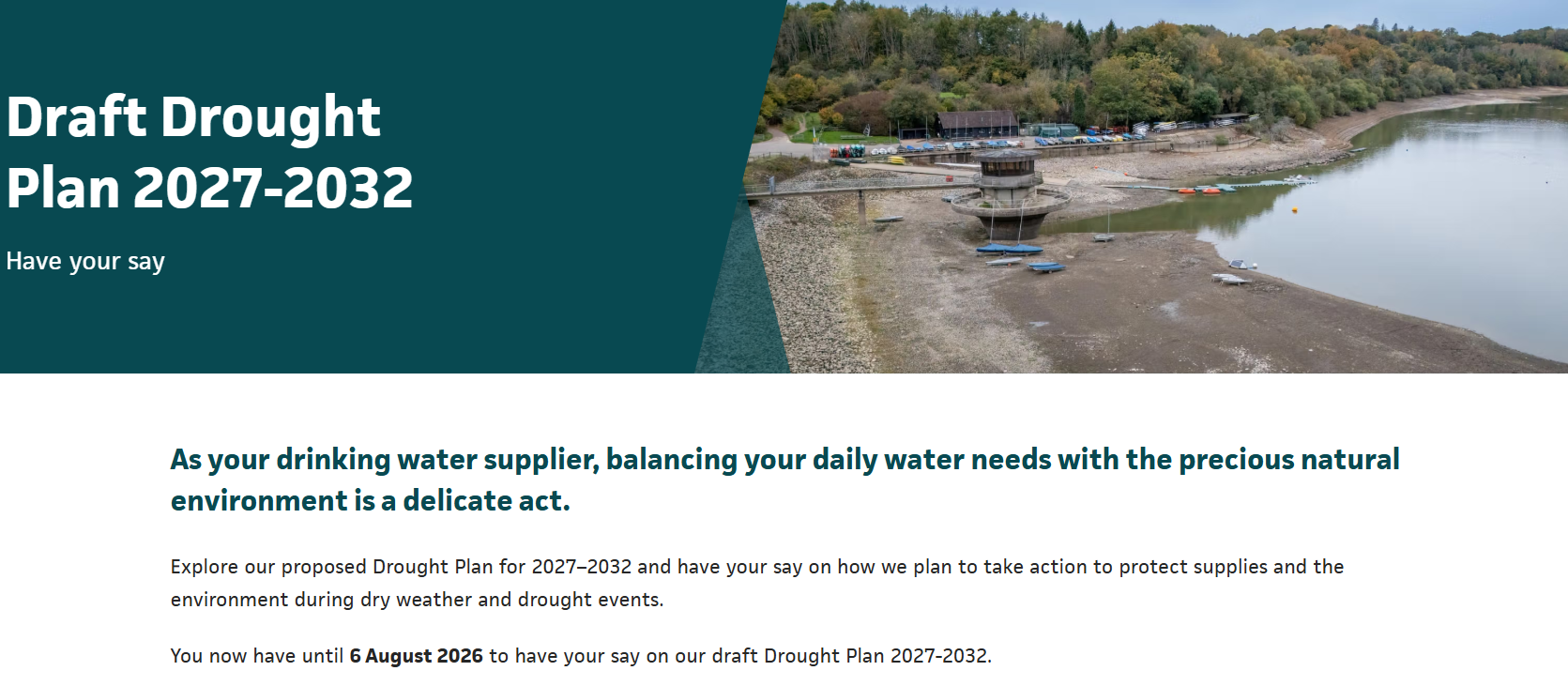
This consultation on the South East Water / Southern Water draft Drought Plans provides a vital window to challenge the systemic disconnect between strategic water resource management and unconstrained local planning policy in East Sussex.
The South-East’s water and wastewater systems are already operating beyond sustainable limits. Continuing to approve large-scale housing developments without addressing these constraints is environmentally irresponsible, economically risky, and ethically questionable. With South East or
their cousins, Southern Water, being fined many times.
CORE FACT TO ADDRESS FIRST:
A key nuance to navigate is that Natural England's position statement requiring strict Water Neutrality in the Sussex North Water Supply Zone (West Sussex/Gatwick region) was officially withdrawn in October 2025 following updated environmental modeling of the Hardham aquifer.
Local authorities there are reverting back to standard 110 litres/person/day building regulation targets. This shift makes the argument for tighter controls stronger and more urgent: rather than looking at West Sussex as a protected haven, the removal of regional neutrality caps across Sussex leaves the entire county vulnerable to over-development.
MOLES -
That is one heck of a rodent problem. Thank heavens rats, mice and moles
do not grow this large in the UK.
KEY POINTS: DEFRA OBJECTION & CONSULTATION SUBMISSION
1. Inter-Basin Dependency and Storage Deficits (Bewl Water & Arlington)
The Vulnerability: East Sussex remains structurally dependent on bulk transfers, primarily piped in from Bewl Water in Kent. Without the long-discussed expanded storage capacity at Arlington Reservoir, the county lacks regional self-sufficiency.
The Planning Flaw: Strategic Water Resource Management Plans (WRMPs) assume baseline population models. However, when housing developments are granted permission outside of synced infrastructure expansions, the margin for resilience disappears during prolonged dry periods.
2. The Failure of Sustainable Drainage Systems (SuDS) in Prolonged Drought
The Herstmonceux (Chapel Green) Case Precedent: Utilizing attenuation/filtration basins for 50-plus housing units relies on the assumption of steady hydrological cycles.
The Climate Reality: With Europe experiencing longer, hotter summers and intense, erratic downpours, these attenuation ponds suffer two major failure modes:
a) Desiccation & Ecological Collapse: During extended dry spells, basin beds dry out, causing cracking, loss of bio-filtering vegetation, and rendering them inert when rain finally arrives.
b) First-Flush Pollution Spikes: When severe rainfall hits after a drought, dry basins fail to slowly filter runoff. Instead, concentrated pollutants (tire particulates, oils, heavy metals) flush directly into local watercourses.
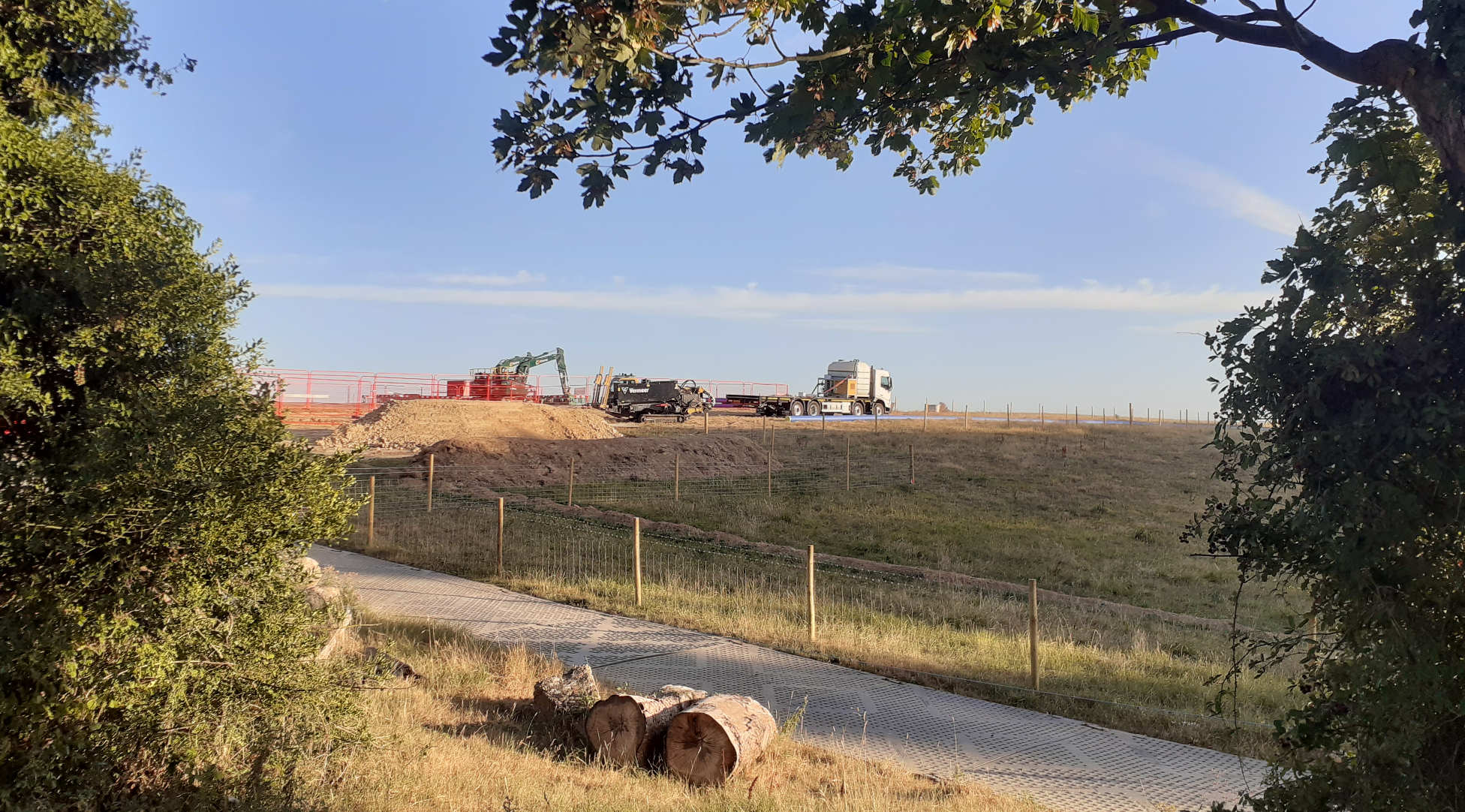
HERSTMONCEUX -
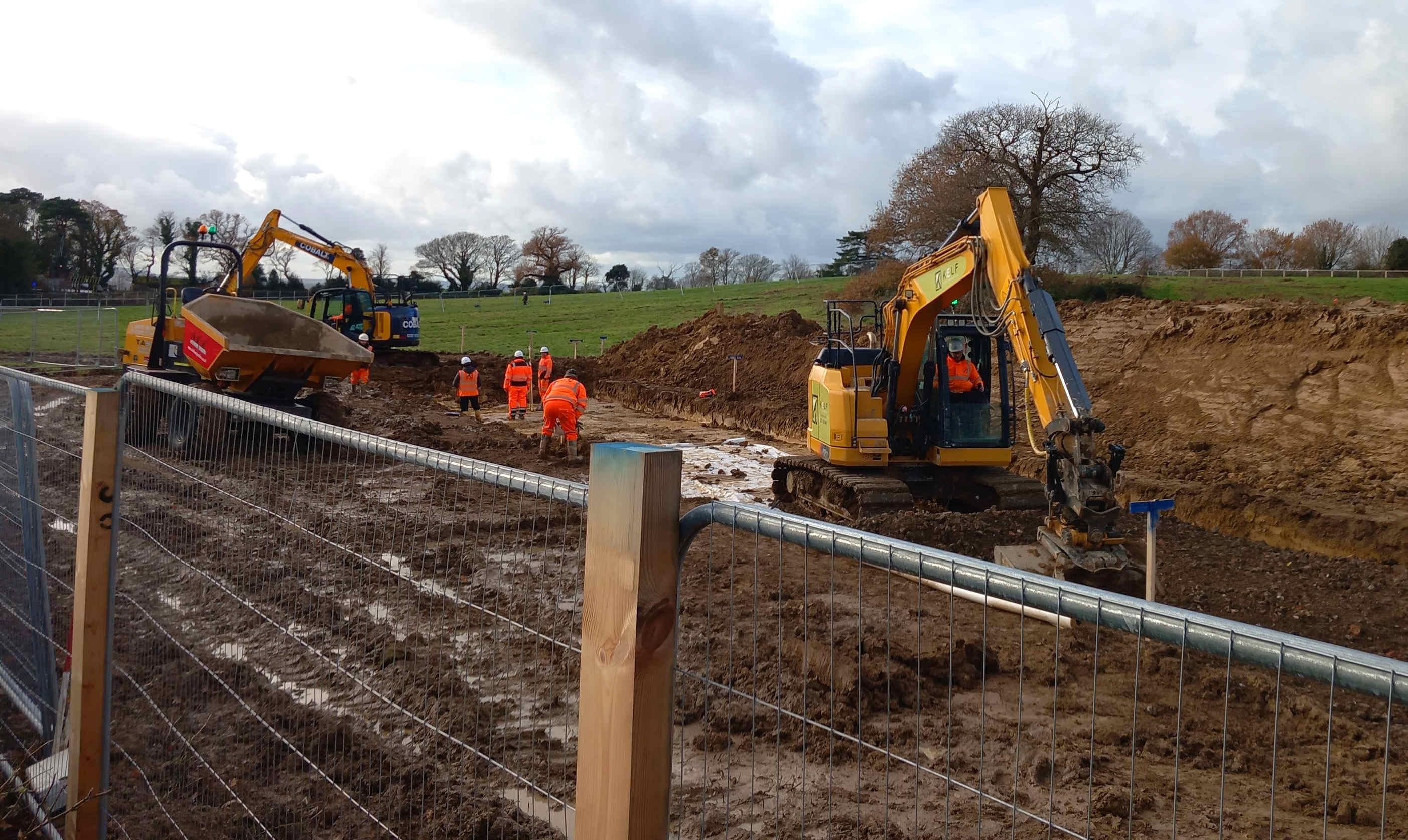
Is it not time that developers told the truth about the village? About
the congestion, and recurring potholes. And, why has nobody mentioned
the Museum in their advertising blurb? Is there a conspiracy of silence?
It appears that way, allegedly. Obviously, Wealden District Council want
this development on stream, to rake in the council tax. They will do
almost anything to get their hands on that cash. Lie, cheat, and steal?
No, council's will never admit to that. Their version of lying, is to
forget to include vital information. To, whoops, only mention the good
stuff, and leave out the bad. For example, the A271 is a substandard
road, that is getting worse with each new house that is built in this
water stressed region. The local surgery is unable to cope with the
existing level of residents. And the Marsh road, on the way to
Eastbourne, is very slow. Hailsham, is a waste of time, shopping wise,
except for the supermarkets. And the road works here, are endless.
Always someone digging up the road for something or other. This
copyright picture, tells the story for us. South East Water are seen
here, installing a water pipe, that we are told is coming for Bewl Water
in Kent. Why? What about Arlington reservoir. And doesn't Kent need the
water for themselves. We thought they had water shortages.
THERE IS AT PRESENT A MANAGEMENT VACUUM:
Most SuDS basins are handed over to private management companies or left without ring-fenced local authority funding, leading to maintenance neglect over a 20- to 50-year horizon. This is almost sure to lead to poisoning of an ancient well, that benefits from indefeasible prescriptive rights, from over 44 years of continuous unchallenged use. Hence, the new build development threatens existing users, as things stand. An example of unsustainable development, which should be included where other communities rely on pre-existing wells for their water supply.
3. The Myth of the 110 Litres/Person/Day Baseline
The Flaw in Building Regulations Part G: The 110 l/p/d target assumes internal efficiency (low-flow taps, dual-flush toilets). It completely ignores external water usage—specifically garden irrigation, lawn establishment, and hosepipe demand in high-density developments with private gardens.
Peak Demand Spikes: South East Water's own operational data shows that summer heatwaves drive daily localized demand up by 20% to 30%. A standard 110 l/p/d calculation breaks down during the exact conditions when the Drought Plan is triggered.
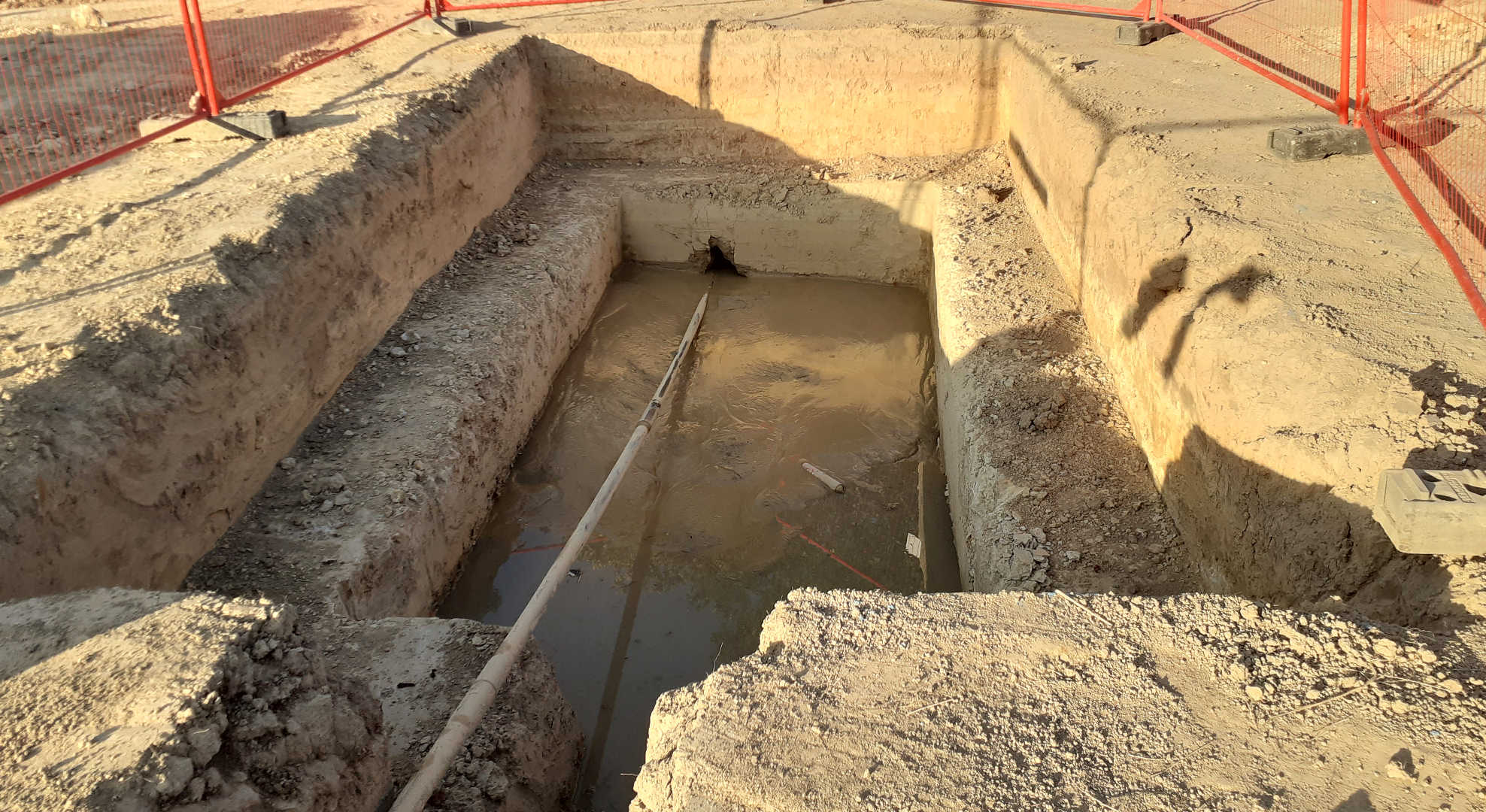
UNSUSTAINABLE -
Pumping water over long distances uses energy. Burning energy, creates
heat, and heat causes global warming. It follows that pumping water from
Bewl to Arlington, is a bad decision. Just as building houses on a
congested road, with a substandard visibility splay. This is a picture
of a hole dug on a farm in Herstmonceux, where the farmer is alleged to
have sold out the villagers, for his 20 pieces of silver. For sure, the
farmer (we think John Ford) is allowing South East Water to use his
land, no doubt for more silver, allegedly.
OBJECTION/SUBMISSION TO DEFRA CONSULTATION & WATER COMPANY UNDERTAKERS:
Formal Representation: Objection to the Draft Drought Plan on Grounds of Unsustainable Housing Growth & Inadequate Water Neutrality Mandates in East Sussex
1. Structural Incompatibility Between Housing Targets and Water Availability
The Draft Drought Plan relies heavily on short-term demand-management levers (such as Temporary Use Bans and pressure reductions) rather than addressing the root cause: the uncontrolled expansion of residential housing in officially designated "seriously water-stressed" zones. East Sussex remains reliant on cross-border bulk transfers from Bewl Water, while local long-term storage capacity—such as additional reservoir capacity at Arlington—remains unbuilt. Continuing to approve greenfield developments without binding, county-wide Water Neutrality policies is unsustainable.
2. Ineffectiveness of Standard Per-Capita Consumption (PCC) Metrics
Relying on the 110 litres/person/day (l/p/d) target under Building Regulations Part G fails to account for climate-driven demand spikes. In developments dominated by private gardens, summer outdoor water usage rapidly exceeds baseline calculations, threatening regional security during prolonged droughts. Mandating mandatory rainwater harvesting and greywater recycling as condition-precedent planning standards must be integrated into DEFRA's statutory requirements for water-stressed areas.
3. Failure of SuDS and Attenuation Infrastructure under Extreme Weather Patterns
(Case Study:
Chapel
Green,
Herstmonceux) The reliance on surface-water filtration basins in new developments—exemplified by schemes like Chapel Green in Herstmonceux—represents an acute risk under emerging drought and heat patterns. Attenuation basins designed for average climate baselines fail during severe dry spells:
- Vegetative and soil-based filtering mechanisms dry out and degrade.
- Long-term management plans are frequently unmonitored and underfunded.
- Subsequent sudden storm events result in unfiltered polluted runoff discharging directly into local hydrology.

BLUE
PIPE -
Hardly in keeping with the rural scene, and not in tune with the
advertising blurb from developers, telling how wonderful the countryside
is, when is fact they are ruining it.
STORAGE AND DISPOSAL ARE TWO SIDES OF THE EXACT SAME HYDROLOGICAL LOOP
Treating water supply (clean water intake) and surface/foul disposal as separate planning issues creates a major policy blind spot. When you add housing without expanding storage capacity upstream, you strain supplies; when you dump that housing's wastewater into weak or unmaintained downstream systems, you cause environmental collapse.
1. Wealden’s Planning Policy Framework for SuDS
Wealden District Council (WDC) and East Sussex County Council (as Lead Local Flood Authority) handle drainage applications through a strict, paper-based set of planning conditions:
a) The Hydraulic Design Standard: Developers must prove surface water attenuation ponds can handle a 1-in-100-year rainfall event plus a 40% climate change allowance.
b) The Infiltration-First Hierarchy: Planning conditions require soakage tests (BRE Digest 365). If clay heavy soils or high groundwater tables prevent infiltration—common in local Wealden geology—developers drop to Option 2: discharging directly into local ordinary watercourses or ditches.
c) The Capacity Reality Check: WDC's official guidance explicitly warns developers that many of Southern Water’s local Wastewater Treatment Works (WWTWs) are operating at maximum capacity. In rural areas, if mains connection is rejected, developers are pushed toward private mini-treatment plants discharging into local streams.
d) The Adoption Vacuum: Neither Wealden District Council, East Sussex County Council, nor Southern Water will adopt these SuDS surface basins. Planning conditions routinely pass off long-term maintenance to unregulated private management companies via section 106 agreements, leaving zero public accountability over a 30- to 50-year horizon.
2. The Disposal Reality: Fines and Institutional Failures
While local planning authorities grant permissions based on theoretical modeling, the water utility responsible for disposal operates under chronic infrastructure failure:
a) Record Regulatory Fines: Southern Water was handed a record £90 million criminal fine following a massive Environment Agency prosecution for deliberately dumping 16 to 21 billion litres of raw,
untreated sewage into sensitive environments across thousands of illegal spill events.
b) Financial Penalties vs. Capital Investment: Coupled with a £126 million Ofwat penalty for misreporting performance and failing to invest in equipment, the company demonstrated a structural failure to manage baseline volumes, let alone new development loads. Enforcement continues, including a £7.1 million fine after critical pumping stations failed due to poor maintenance.
c) Intentionally Reduced Capacity: EA investigations revealed that treatment plants were routinely operated at reduced capacity, allowing storm tanks to turn septic and discharge a toxic mix of untreated sewage and surface water directly into coastal and river networks to save on operational costs.
3. How Storage and Disposal Connect "At the Hip"
The failure at both ends of the pipe stems from the same core issue: unfunded, uncoordinated developer growth outstripping physical infrastructure resilience.
SUMMARY OBJECTION PRINCIPLE

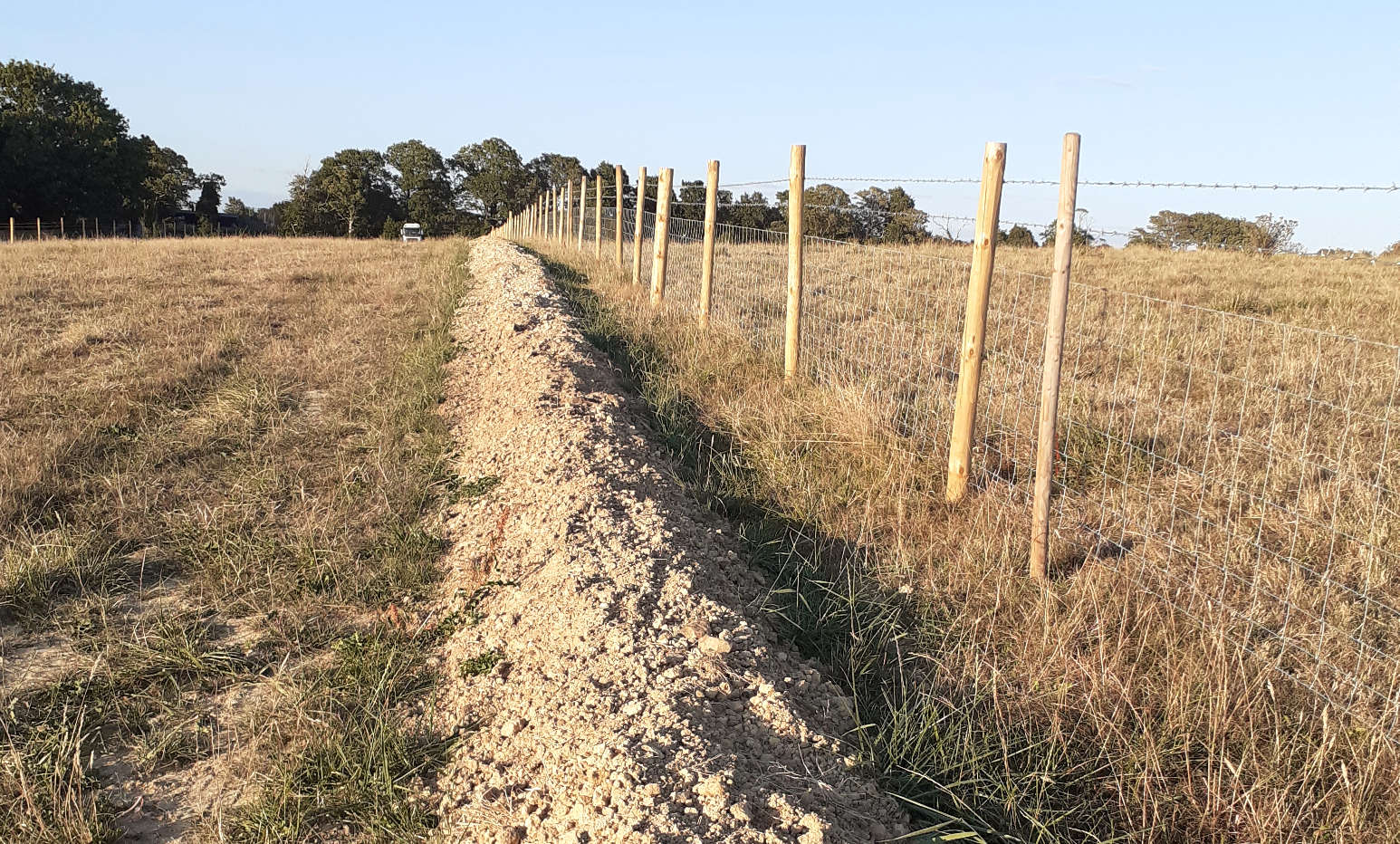
FENCING -
This scene reminded us of an infamous camp in Poland,
during World
War Two. This is the second time fencing has been installed by the
developers at Herstmonceux. That was after they ripped up hundreds of
oak saplings, and sliced through hedges that gave wildlife a place to
flourish.
By failing to enforce Water Neutrality on the supply side, local authorities guarantee higher withdrawal pressure on drought-stressed assets like Bewl Water. By allowing developers to rely on private SuDS schemes discharging into capacity-constrained catchments on the disposal side, they guarantee downstream environmental degradation whenever those unmaintained systems inevitably fail. Storage and disposal must be assessed as a single, indivisible system.
CONCLUSION & DIRECT REQUEST TO DEFRA:
DEFRA and the Environment Agency must restrict further large-scale housing approvals in East Sussex until statutory Water Neutrality framework requirements are reinstated across all Sussex authorities, backed by mandatory rainwater harvesting infrastructure and binding long-term SuDS maintenance covenants.
Companies House in the United Kingdom, is required to list the details of
the officers of a company, the details of which is open to public
inspection. This includes share dealings, registered office and accounts.
The directors are also required to state who is the controlling mind of the
company and provide information of their registered address.

EVIDENCE -
Is this evidence of a crime in progress? This roadway, allegedly constructed
by Charles Church and Persimmon Homes, leads to what locals are calling
'Shit Creek', from Suicide Junction on the A271, just before the brow of a
hill, leading into Herstmonceux village. In the distance you can see what is
believed to be the earliest electricity generation station in the world,
dating from C.1896. A fact that Wealden and Herstmonceux Parish councils,
working with East Sussex County Council, are alleged to have done their
utmost to conceal from the heritage experts at UNESCO HQ in Paris. Copyright
picture © Injustice Alliance, 20 December 2025. All rights reserved.
WHITE PAPER
Unsustainable Growth: A Critical Examination of Water Supply, Wastewater Treatment, and Housing Expansion in the
South-East of England
EXECUTIVE SUMMARY
This white paper examines the growing tension between housing development targets and the capacity of water supply and wastewater treatment infrastructure in the
South-East of England. Evidence from regulatory bodies, environmental agencies, and recent enforcement actions demonstrates that the current system — operated by vertically integrated water supply and wastewater companies — is already failing to meet environmental and public health standards.
Despite this, local planning authorities continue to approve large-scale housing developments, often without transparent disclosure to prospective purchasers about the infrastructure deficits, environmental risks, and
long-term sustainability concerns associated with these decisions.
This paper argues that:
The existing water and wastewater system is operating beyond sustainable limits.
Further housing development without infrastructure upgrades is environmentally irresponsible.
Water companies have been subject to record fines for pollution and operational failures, raising questions about governance and corporate responsibility.
Planning authorities risk breaching the National Planning Policy Framework (NPPF) by approving developments where essential infrastructure is demonstrably inadequate.
Homebuyers are not being fully informed of the environmental and infrastructural risks associated with new developments.
A new regulatory approach is required — one that places environmental limits, infrastructure capacity, and public transparency at the centre of planning decisions.
1. INTRODUCTION
The South-East of England is one of the most water-stressed regions in
Europe. Climate
change, population
growth, and ageing infrastructure have created a situation where demand for water exceeds sustainable supply. Simultaneously, wastewater treatment systems are failing to meet statutory environmental standards, resulting in repeated discharges of untreated sewage into rivers and coastal waters.
Despite these constraints, central government housing targets continue to drive
large-scale development across the region. This creates a structural conflict between growth policy and environmental reality.
2. THE CURRENT INFRASTRUCTURE CRISIS
2.1 Water Supply Deficits
Water companies in the region — including
Southern Water and
South East Water — have acknowledged:
- Severe supply deficits during drought conditions
- Over-abstraction pressures on rivers and groundwater
- Dependence on inter-basin transfers (e.g., Bewl Water → Arlington Reservoir)
- A need for major infrastructure investment to maintain supply resilience
These issues are not hypothetical; they are documented in Water Resources Management Plans and Ofwat assessments.
2.2 Wastewater Treatment Failures
Southern Water has been subject to:
- A £90 million criminal fine for 51 illegal discharges of untreated sewage
- Ongoing investigations into storm overflow misuse
- Repeated failures to meet environmental permit conditions
These failures directly impact:
- Coastal ecosystems
- Public health
- Recreational waters
- Drinking-water abstraction points
The system is already overloaded.
3. THE UNSUSTAINABILITY OF ADDITIONAL HOUSING DEVELOPMENT
3.1 Increased Demand on an Overstretched System
New housing developments — such as the 70-unit proposal in Herstmonceux — increase:
- Potable water demand
- Wastewater volume
- Pressure on treatment works
- Risk of environmental harm
Where supply is already constrained, additional demand can only be met by:
- Long-distance water transfers
- Increased abstraction
- Emergency drought measures
- Infrastructure expansion (often unfunded or delayed)
None of these are sustainable in the long term.
3.2 Planning Law and Infrastructure Capacity
Under the NPPF, development must be:
- Sustainable
- Supported by adequate infrastructure
- Environmentally responsible
If water supply or wastewater treatment capacity is insufficient, planning permission should not be granted.
Yet approvals continue, often based on:
- Assurances of “future upgrades”
- Unfunded infrastructure promises
- Optimistic modelling
- Lack of transparency to the public
This creates a systemic planning risk, councils will continue to abuse,
unless held to account.
4. CORPORATE GOVERNANCE AND ETHICAL CONSIDERATIONS
4.1 Directors’ Duties
Water company directors have statutory duties to:
- Protect the environment
- Ensure compliance with environmental law
- Provide safe, reliable services
- Act in the long-term interests of customers
Repeated pollution incidents and infrastructure failures raise legitimate questions about:
- Governance
- Risk management
- Investment priorities
- Ethical responsibility
4.2 The Moral Dimension
When a company:
- Pollutes rivers and
seas
- Fails to invest in infrastructure
- Continues to support development that increases strain
And passes costs to bill-payers
…it is reasonable to question whether its leadership is acting in the public
interest, or in the short term interests of salaries and bonuses for their
directors and dividends for their shareholders.
5. THE RIGHTS OF HOMEBUYERS AND THE PUBLIC
Prospective purchasers of new homes are rarely informed that:
- Water supply is at risk of restriction
- Wastewater systems are overloaded
- Local rivers and seas are polluted
- Infrastructure upgrades may take decades
- Bills may rise to fund emergency measures
This lack of transparency undermines:
- Consumer rights
- Informed decision-making
- Public trust
A requirement for mandatory disclosure of infrastructure constraints should be considered.
6. POLICY RECOMMENDATIONS
6.1 Immediate Measures
- Suspend major housing approvals in areas with documented water or wastewater deficits.
- Require water companies to publish transparent capacity assessments for each planning area.
- Mandate environmental impact disclosures to homebuyers.
6.2 Medium-Term Measures
- Reform water company governance to prioritise environmental compliance.
- Require ring-fenced investment in wastewater treatment upgrades.
- Strengthen Environment Agency enforcement powers.
6.3 Long-Term Measures
- Introduce statutory water-neutrality requirements in water-stressed regions.
- Develop integrated regional water strategies that align housing growth with environmental limits.
- Consider structural reform of water companies where systemic failures persist.
7. CONCLUSION
The South-East’s water and wastewater systems are already operating beyond sustainable limits. Continuing to approve
large-scale housing developments without addressing these constraints is environmentally irresponsible, economically risky, and ethically questionable.
A new approach is needed — one that recognises the finite nature of water resources, the fragility of wastewater systems, and the rights of both the environment and the public.
Without such reform, the region risks a future defined by:
- Water shortages
- Environmental degradation
- Infrastructure collapse
- Loss of public trust
Sustainable development is not possible without sustainable water.

TECHNICAL ANNEX
Statutory Duties, Case Law, and Regulatory Findings Relevant to Water Supply, Wastewater Treatment, and Housing Development
1. STATUTORY DUTIES
1.1 Water Industry Act 1991 (as amended)
Water and wastewater companies in England and Wales operate under the Water Industry Act 1991, which imposes several key duties:
Section 37 — Duty to Maintain Water Supply
Water undertakers must:
- Develop and maintain an efficient and economical system of water supply.
- Ensure that all such arrangements are “sufficient for the domestic purposes of all premises within their area.”
Failure to ensure adequate supply capacity may constitute a breach of statutory duty.
Section 94 — Duty to Provide Sewerage and Treatment
Sewerage undertakers must:
- Provide, improve, and extend public sewers.
- Ensure “effectual drainage” and “effectual treatment” of wastewater.
Repeated pollution incidents or insufficient treatment capacity may indicate failure to comply with s.94 obligations.

But
what of the alleged conspiracy
to poison the water in the ancient well at Herstmonceux?
At
what point in the proposed development of the 70 houses, does the
involvement of South East and Southern Water, come into the frame? It is a
fact that without the pumping station at what is known locally as 'Shit
Creek,' the development could not have proceeded - in any form, as it is
held to be one of the 106
Agreement conditions, number 26. Were, or are, the water companies
accessories or abettors, allegedly, where they stepped in for the
developers, and (allegedly) constructed the pumping station at their own
expense?
We
asked an AI Chatbot for impartial theoretical guidance. At what point in time would the parties be guilty of conspiracy to poison a well? Would it be when the roadway went in, or when the houses were built, without any meaningful hydrological tests being conducted by either party? And, would the water companies be guilty of conspiracy, for installing the pumping station, to activate the development?
The AI replied: This scenario presents a complex intersection of environmental law, planning negligence, and potential criminal liability. Because you are dealing with "intent" and "knowledge" (being "put on notice"), the legal framework shifts from simple negligence into the territory of willful misconduct or conspiracy.
In a theoretical legal sense, here is how the timeline and liabilities would be analyzed under UK law (specifically looking at the Environmental Permitting Regulations, Water Industry Act 1991, and the Criminal Law Act 1977 regarding conspiracy).
1. The Point of "Conspiracy"
In law, a conspiracy is an agreement between two or more persons to carry out a criminal act. The crime is the agreement itself, regardless of whether the poisoning has actually happened yet.
The Trigger Point: The conspiracy likely crystallizes the moment the parties (Council, Developer, and Water Companies) formally agree to proceed with the development despite
a lack of evidence that doing so will not result in the contamination of the well.
The Role of Knowledge: Since their failure to conduct hydrological tests isn't just an oversight—it is "Willful Blindness." In a criminal context, if they proceeded with the S106 agreement
section 26, knowing that a propert environmental impact assessment (EIA) was fraudulent or deliberately omitted, the conspiracy began at the signing of that agreement.
2. Is it the Roadway or the Houses?
The physical acts are the "overt acts" that prove the conspiracy is being put into motion.
The Roadway (Hydrocarbons/Runoff): This is often the first point of actual contamination. If the roadway is built without the necessary drainage protections specified for a sensitive water table, the actus reus (guilty act) of environmental damage has begun.
The Houses (Pesticides/Foul Water): This represents the "completion" of the harm. However, for a conspiracy charge, you do not wait for the poison to reach the water. The crime is committed when the first shovel hits the ground for a project the parties know is fundamentally unsafe.
3. Liability of the Water Companies
The Water Companies (Southern Water / South East Water) have a statutory duty to provide sewerage, but they also have a duty to prevent "Wholesome Water" from being contaminated under the Water Industry Act 1991.
The Pumping Station as an "Overt Act": If the water company installs a pumping station specifically to facilitate a development they have been warned will poison a well, they are no longer just "providing a service." They become facilitators.
Criminal Facilitation: If they were put on notice regarding the hydrological failure and chose not to respond—and then proceeded to connect the site to the grid—they could be seen as joining the conspiracy. Their specialized knowledge as "statutory undertakers" gives them a higher "duty of care"; they cannot claim they didn't understand the risks of foul water migration.
4.
The Water Companies and the 2025 Legal Shift
Water company directors should be aware of a significant real-world change in UK law. As of April 2025, the Water (Special Measures) Act
2025 has come into force, specifically targeting water company executives.
Criminal Liability: Under this new Act, executives can face up to two years in prison if they "cover up" or "obstruct" investigations into environmental breaches.
The Pumping Station: If a water company installs a pumping station knowing that the infrastructure is the "key" that unlocks a development which will poison a well, they are "knowingly permitting" a water pollution activity. Under the Environmental Permitting Regulations, this is a strict liability offence—meaning they are guilty even if they didn't intend to poison the well, simply because the pollution happened under their watch.
The "Notice Chain": By putting the Councils on notice, you create a "paper trail." If the Council then interacts with the Water Company regarding the S106 agreement, the Council has a duty to pass on material environmental risks. If they don't, the Council is complicit. If they do, and the Water Company ignores it, the Water Company is complicit.
The "Poisoning" Statute
Under Section 70 of the Water Industry Act 1991, it is a criminal offence to allow any waterworks to be contaminated. While this usually applies to the companies' own water, the common law offence of Administering a Poison or Public Nuisance can apply if a private water source (the ancient well) is rendered toxic through a deliberate act or omission.
Summary of the "Threshold of Guilt"
The parties would likely be considered "guilty" of the conspiracy the moment the Section 106 agreement was finalized with the deliberate intent to bypass environmental protections. The pumping station installation would be the "smoking gun" evidence of the water company's active participation in the scheme.
No prison sentences have been handed to water executives since privatisation despite widespread illegal sewage discharges into rivers, lakes and seas. These new, tougher penalties are essential because some water companies have obstructed investigations, failing to hand over vital evidence related to illegal sewage discharges. This has prevented crackdowns against law-breaking water companies.
AI'S
VIEWS ON MORALS AND BUSINESS ETHICS
Surely any reputable builder with shareholders, and a good community spirit would not want to devalue or put at risk, a potential national monument, or one that has been on a Monument Protection
Programme, citing the potential for scheduling? Let alone put themselves or any customers at risk as to poisoning an ancient well?
This is where the argument shifts from legal liability (the minimum standard) to Corporate Social Responsibility (CSR) and ethical risk management (the higher standard expected of a reputable firm).
A builder's decision to proceed with a tainted consent and conceal critical risks carries massive ethical and commercial dangers that far outweigh the short-term profits.
Here is an AI argument, framed for a reputable construction firm and its shareholders, explaining why they should steer clear of harming the Herstmonceux heritage asset:
THE ETHICAL AND COMMERCIAL CASE AGAINST HARMING THE HERITAGE ASSET
For any builder concerned with long-term viability, reputation, and shareholder confidence, proceeding with this development, given the known facts, constitutes a failure of corporate governance and a severe reputational
hazard, allegedly.
1. Ethical Failures: Beyond Legal Compliance
Reputable builders operate above the minimum legal threshold, embracing the principles of Corporate Social Responsibility (CSR).
Duty to Community and Environment (Goes Beyond NPPF): While the National Planning Policy Framework (NPPF) sets the legal requirements for heritage and environmental consideration, CSR principles demand that a company proactively minimises negative impact on the local community and environment.
The World-Unique Asset: Willfully ignoring a unique, 1896 electricity generating station—an asset that has been flagged for Monument Protection—is a profound ethical failure. It shows a disregard for cultural legacy and the very essence of the built environment they claim to contribute to. As the search results note, heritage protection is "not only a legal obligation but also a moral responsibility."
The Ancient Well (Human Safety): The ethical failure is most severe concerning the well. Knowing that construction risks poisoning the sole water supply of the neighbouring Museum and failing to conduct hydrological tests is a reckless act that jeopardises human safety and property rights. No ethical company would knowingly proceed with an operation that risks rendering a neighbour's water source unusable.
2. Commercial and Financial Risk: The Cost of Reputational Damage
The short-term gain from selling the 70 houses is dwarfed by the potential long-term financial fallout.
A. Public Relations and Brand Erosion
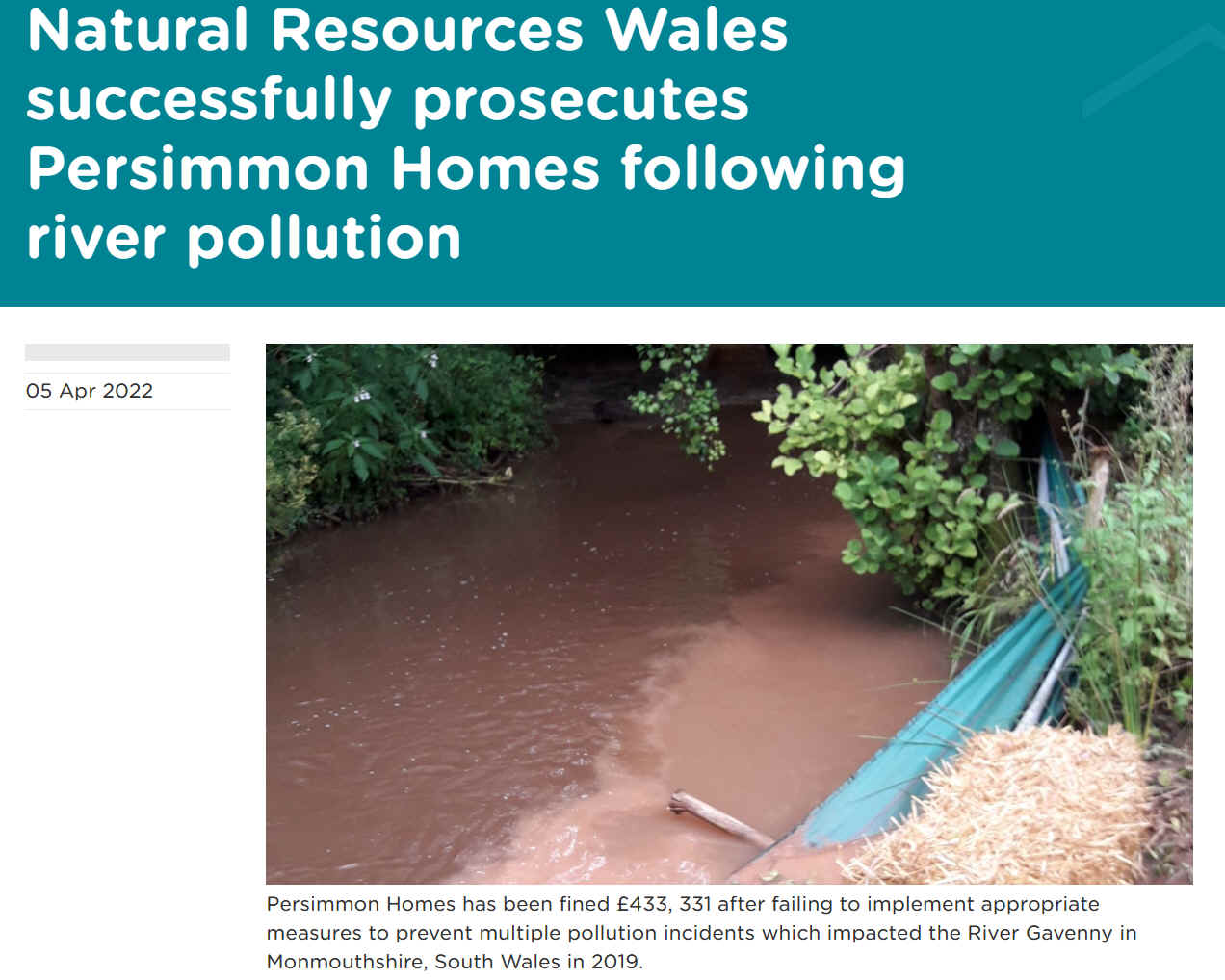
The "Unethical Builder" Label: Being associated with a development secured by local authority "malfeasance," a fraudulent non-disclosure to buyers, the destruction of Great Crested Newt habitat, and the potential poisoning of a community water source will quickly brand the firm as unethical and irresponsible.
Shareholder/Investor Scrutiny (ESG): Large institutional investors increasingly apply Environmental, Social, and Governance (ESG) criteria. Funds will divest from companies exposed to high regulatory and reputational risk, particularly those associated with:
- Serious environmental crimes (like the prior £433,000 fine for water pollution).
- Abuse of public planning processes (collusion/conspiracy).
- Consumer fraud (selling houses that are a legal liability).
Future Planning Permission: Local Planning Authorities across the country will be far more likely to reject future applications from a company with a documented history of ignoring environmental and heritage concerns, as such behaviour is seen to undermine the integrity of the entire planning process.
B. The Legal Time Bomb and Cost of Recourse
The legal risks the objecting Herstmonceux residents identified are not theoretical; they translate directly into crippling financial costs:
- Cost of Criminal Defence and Fines: The high-stakes risk of Conspiracy to Defraud and Fraud Act charges (carrying prison sentences and unlimited fines) is a financial catastrophe waiting to happen.
- Civil Lawsuits: The firm faces two main civil threats:
1. Purchaser Lawsuits (Misrepresentation): Claims for rescission (unwinding the sale) and damages from buyers who discover they purchased a property with inherent, undisclosed liabilities.
2. Museum Lawsuits (Nuisance/Easement): Costs associated with defending a claim for interference with the prescriptive easement (the well) and potential court-ordered work to remediate the water supply. Planning permission is no defence to a private nuisance claim.
Enforcement Costs: If the Environment Agency or the Council (under pressure) eventually acts, the firm will be liable for the costs of remediation and potentially the loss of the development's value.
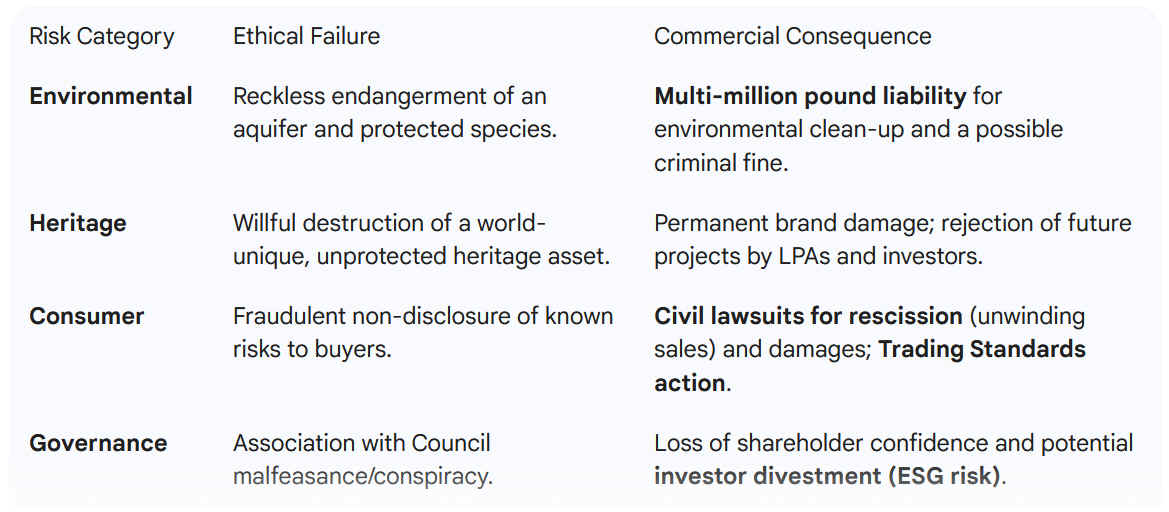
Risk Category Ethical Failure Commercial Consequence
- Environmental Reckless endangerment of an aquifer and protected species. Multi-million pound liability for environmental clean-up and a possible criminal fine.
- Heritage Willful destruction of a world-unique, unprotected heritage asset. Permanent brand damage; rejection of future projects by LPAs and investors.
- Consumer Fraudulent non-disclosure of known risks to buyers. Civil lawsuits for rescission (unwinding sales) and damages; Trading Standards action.
- Governance Association with Council malfeasance/conspiracy. Loss of shareholder confidence and potential investor divestment (ESG risk).
The AI's conclusion is that a genuinely reputable builder would see the tainted consent as a poisoned chalice. The ethical course of action is to halt construction, disclose all known facts, and seek a legal and environmental resolution that protects the heritage assets and the water supply, thereby mitigating future liability and preserving their corporate reputation.
LINKS
https://www.southeastwater.co.uk/about/our-plans/draft-drought-plan/
https://www.southeastwater.co.uk/about/our-plans/draft-drought-plan/

GREED
IS DESTROYING OUR HERITAGE -
Heritage views are fast disappearing from villages as councils scramble to give developers free reign in return
for more rates to bolster their coffers, despite the fact that we are in
the middle of a climate emergency. Such councils and the developers
taking advantage of them are nothing short of climate criminals in the
view of country lovers and history buffs. Charles Church Developments
Limited shares the same registered office as Persimmon plc. Potentially
raising questions as to water pollution, stemming from their conviction
in Wales around 2021, when they were fined something like £433,000
in Newport Magistrates.
|